
The United States Patent and Trademark Office has just issued U.S. Patent Number 12,115,279 for demineralized bone fiber implant compositions and methods for rotator cuff and anterior cruciate ligament (ACL) repair.
Fourth Patent Issued for Demineralized Bone Fiber Implants
1 min read Premium comments
#enfix#tetrousSecondary
The implant system is under the brand name EnFix®, which represents a family of allograft products. It is manufactured by Tetrous, Inc., a Sherman Oaks-based start-up dedicated to bone-to-tendon healing following orthopedic surgery. This is the fourth patent that the company has been issued related to its EnFix family of implants. Tetrous also has an exclusive license to the demineralized bone fiber technology used in its products.
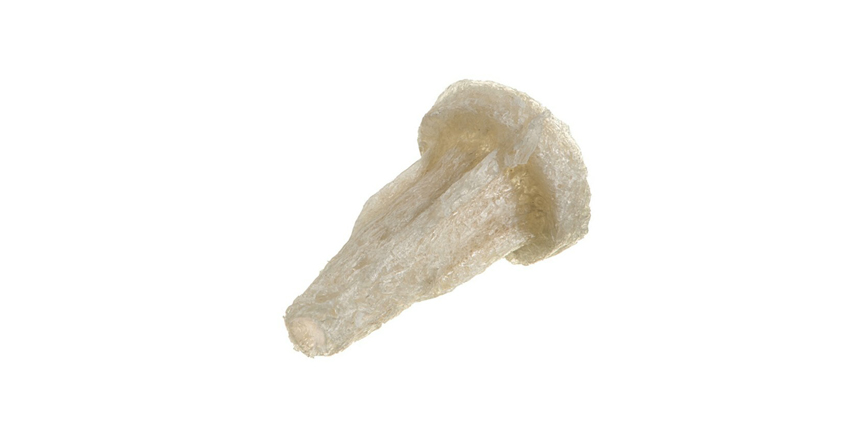
The EnFix implants have been created to support healing at the tendon/bone interface. According to the company, the 100% demineralized bone fiber implants provide osteoinductivity and osteoconductivity. Its additional technology “imparts shape retention to the device, even in the wet environment of arthroscopic surgery.”
The EnFix family of allograft products includes EnFix RC™ and EnFix TAC™ for rotator cuff repair. Since July 2023, over 700 of the EnFix RC and EnFix TAC implants have been implanted in the United States and Australia.
According to the company, six months after surgery follow-up MRIs “are consistently showing reformation of the enthesis, thickening of the tendon and little to no edema.”
Most of the surgeries have been for rotator cuff repair. However, Tetrous is developing its technology to include additional applications. In the future, Tetrous will expand its applications to include hip, biceps, Achilles, and ACL procedures.
Andy Carter, Ph.D. co-founder and director of Tetrous as well as the co-inventor on the issued patent, told OTW, “We are pleased that the U.S. Patent Office has yet again recognized the uniqueness of our technology and has granted this additional patent.”
Dr. Carter continued, “Our growing intellectual property portfolio provides Tetrous a sustainable competitive advantage in the enthesis repair market.”
Author
React:
Discussion
This is a fascinating development. In my practice we've seen similar outcomes with the revised protocol. The key differentiator seems to be patient selection criteria. Has anyone else noticed the correlation with BMI thresholds?
Great point. I'd push back slightly on the conclusion, the sample size in the cited study is too small to draw population-level inferences. That said, the directional signal is compelling and worth a larger RCT.
We implemented a similar approach last year. Early results are promising but we're still gathering 12-month follow-up data. Happy to share our protocol if anyone is interested.
Join the conversation
Orthopedic professionals are discussing this. Sign in and upgrade to read every comment and add your voice.