
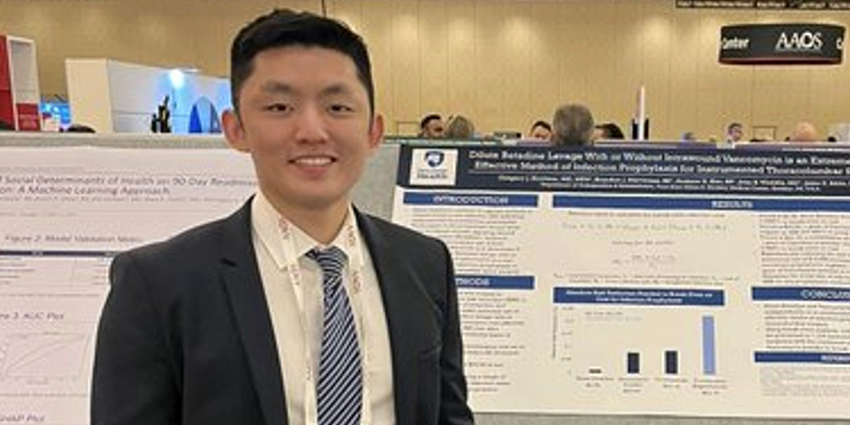
Andrew Kim, B.S. was honored with a “Best Paper” at the recent North American Spine Society (NASS) meeting in Chicago. His work (publication in progress), is titled, “Neurologic Adverse Events Following Three-Column Osteotomy: A Prospective Multicenter Study.”
Andrew Kim Wins Best Paper at 2024 NASS
1 min read Premium comments
#adultspinaldeformity#threecolumnosteotomy
In the first study to compare sensory and motor complications between adult spinal deformity patients with and without three-column osteotomies, Kim and his colleagues looked at 553 adult spinal deformity patients who underwent this surgery. Those with and without three-column osteotomies were compared with respect to patient demographics, surgical characteristics, and neurologic complications.
“In adult spinal deformity surgery, three-column osteotomies are often used to correct severe/rigid deformities,” said Kim to OTW. “Current literature has found an association between three-column osteotomies and high complication rates, with variable impact on postoperative neurologic outcomes. Thus, our research study aimed to identify the rate of neurologic complications following adult spinal deformity surgery and characterize the differences in incidence between patients with and without three-column osteotomy.”
“In our study,” explained Kim to OTW, “we found that adult spinal deformity patients who underwent three-column osteotomy were:
- more likely to be revision patients (7% vs. 35.0%),
- present with sagittal deformity (43.9% vs. 31.0%), and
- have greater operating room time (455.6 vs. 407.2 minutes) and
- have estimated blood loss (1,971.2 vs. 1,286.2 cc) compared to those without three-column osteotomy.
Additionally, there was a greater overall incidence of early postoperative adverse neurologic events in patients who underwent three-column osteotomy compared to patients without three-column osteotomy.”
“Interestingly, there was no difference in lower extremity motor strength at 1-year follow-up or 1-year change from baseline between adult spinal deformity patients with and without three-column osteotomy.”
Importantly, said Dr. Kim, among adult spinal deformity patients, risk of complication should not be considered a contraindication when deciding whether to perform three-column osteotomy … or not.
“Our study demonstrates there was no change in lower extremity motor strength or neurologic deficits at 1-year follow-up. Surgeons should choose the procedure they feel is best in
Author
React:
Discussion
This is a fascinating development. In my practice we've seen similar outcomes with the revised protocol. The key differentiator seems to be patient selection criteria. Has anyone else noticed the correlation with BMI thresholds?
Great point. I'd push back slightly on the conclusion, the sample size in the cited study is too small to draw population-level inferences. That said, the directional signal is compelling and worth a larger RCT.
We implemented a similar approach last year. Early results are promising but we're still gathering 12-month follow-up data. Happy to share our protocol if anyone is interested.
Join the conversation
Orthopedic professionals are discussing this. Sign in and upgrade to read every comment and add your voice.