
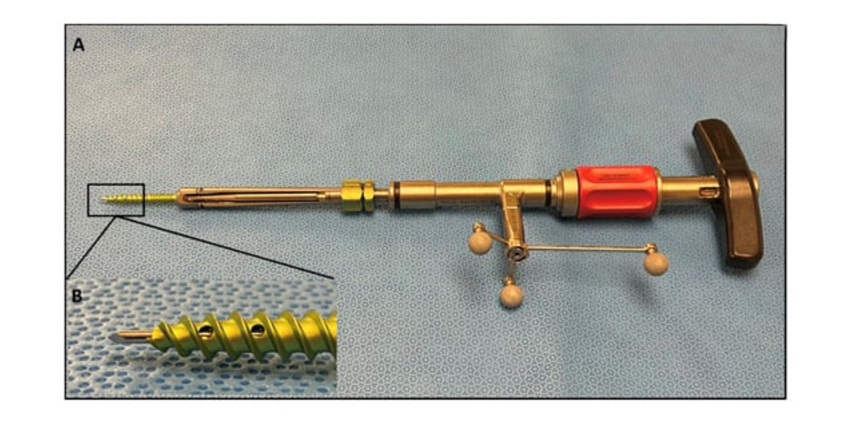
Hoping to shake things up in the pedicle screw placement arena, a team from Weill Cornell Medicine—Department of Neurosurgery, NewYork-Presbyterian Och Spine Hospital has revisited previous work regarding a wireless, Single-Step Pedicle Screw placement system.
Wireless, 3D NAV Pedicle Screw Placement Review
2 min read Premium comments
Secondary#kirschner#llif#lumbarfusion#pediclescrewsystem#tlif
Their study, “High Accuracy of Three-Dimensional Navigated Kirschner-Wire-Less Single-Step Pedicle Screw System (SSPSS) in Lumbar Fusions: Comparison of Intraoperatively Planned versus Final Screw Position,” appears in the August 29, 2024 edition of Brain Sciences.
In their prior work, the researchers reported that 90% of pedicle screws were inserted without a breach. Digging deeper, the team, while acknowledging that their study only assessed anatomical accuracy postoperatively with CT scans, decided to compare planned intraoperative screw trajectories with final screw position using the Gertzbein and Robbins classification system.
Comparing intended pedicle screw placement to final screw position offers surgeons a better evaluation of how closely their surgical execution matches their planning, explained the authors.
“If there are any major deviations between intended and final screw position, surgeons can study these errors and devise plans to avoid them in the future. Given our previously reported 90% grade 0 breach, we anticipated a high percentage of screws placed exactly as intraoperatively planned,” they wrote.
“The idea was to simplify the tools that we use in the workflow for navigation and percutaneous placement of screws,” said Roger Härtl, M.D., the Hansen-MacDonald Professor of Neurological Surgery and Director of Neurosurgery Spine at Weill Cornell Medicine, to OTW.
“In the past, the insertion of the screws required monitoring multiple separate tools and instruments for the insertion of screws. This new system now combines everything in one tool. This was really developed by the technical engineers at DePuy Synthes. It greatly facilitates and improves the workflow for his placement of screws either with Ap fluoro or 3-D navigation.”
For the study, the research team enrolled patients who’d received instrumented fusion for lumbar degenerative disc disease. The study patients, all adults, underwent a transforaminal lumbar interbody fusion, anterior lumbar interbody fusion, or lateral lumbar interbody fusion procedure using a navigable Single-Step Pedicle Screw System workflow.
According to the study authors, the workflow was as follows:
- A skin incision is marked using navigation guidance.
- Navigation is manually verified using the Brainlab pointer to identify and palate a transverse process at a distance from the reference array.
- The navigated screw with the screw driver is calibrated.
- After inserting the screw, the screws are test stimulated with an extended electrode probe. A threshold of 8 mA is used to consider screw repositioning.
- A final intraoperative CT is completed with the navigation reference in place in case of further instrument adjustment or decompression.
- The patient’s wound is generously irrigated and washed after meticulous hemostasis is performed. Osteo-stimulative bone graft is packed under the rod. Local anesthesia is used to infiltrate the muscle and the wound is closed.
A total of 47 patients were included in the analysis. Out of 206 screws, 196 (95%) were accurately placed—no complications. The team found that the Single-Step Pedicle Screw System workflow, even without K-wires and other traditional instruments, facilitates accurate and reliable pedicle screw placement.
Dr. Härtl commented to OTW, “Some surgeons believe that for the safe placement of percutaneous screws it is necessary to use separate K-wires. The study clearly shows that that’s not the case. This again further facilitates the workflow.”
Author
React:
Discussion
This is a fascinating development. In my practice we've seen similar outcomes with the revised protocol. The key differentiator seems to be patient selection criteria. Has anyone else noticed the correlation with BMI thresholds?
Great point. I'd push back slightly on the conclusion, the sample size in the cited study is too small to draw population-level inferences. That said, the directional signal is compelling and worth a larger RCT.
We implemented a similar approach last year. Early results are promising but we're still gathering 12-month follow-up data. Happy to share our protocol if anyone is interested.
Join the conversation
Orthopedic professionals are discussing this. Sign in and upgrade to read every comment and add your voice.