
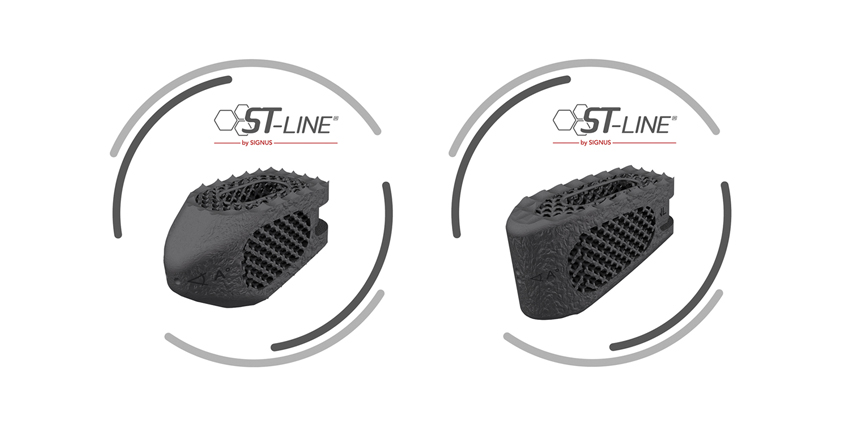
The U.S. Food and Drug Administration (FDA) has granted 510(k) clearance to two intervertebral body fusion devices.
FDA Clears Novel Intervertebral Body Fusion Devices
1 min read Premium comments
Secondary#signus#tetrisrst#tetrisst
According to the FDA 510(k) summary document, the devices are intended for “use at one level in the lumbar spine, from L2 to S1, for the treatment of degenerative disc disease (DDD) with up to Grade I spondylolisthesis.” Further, “DDD is defined as back pain of discogenic origin with degeneration of the disc confirmed by history and radiographic studies.”
The lumbar devices are to be “used in patients who have had six months of non-operative treatment.” Additionally, the devices are intended for “use with a supplemental internal fixation system and with autogenous bone graft and/or allograft comprised of cancellous and/or corticocancellous bone graft to facilitate fusion.”
SIGNUS Medizintechnik GmbH, based in Alzenau, Germany, is the manufacturer and its novel devices, brand named TETRIS® ST and TETRIS® R ST PLIF are cages made from structured titanium (ST).
The novel interbody implants incorporate the SIGNUS toothed cage design. This design, according to the company, lowers the risk of implant migration by providing “secure anchoring in the bone with high primary stability.” According to Signus, the SIGNUS ST promotes bone-on and bone-in growth thanks to its “open, macroporous titanium design resembling natural cancellous bone architecture.”
The unique design of the TETRIS ST allows it to be implanted without the “removal of the posterior vertebral body edges.” The TETRIS R ST, said Signus, “offers an additional rotational technique with a tapered rotational edge, enabling a straightforward, low-impact rotation.”
In order to qualify for the shorter and earlier 510(k) clearance the device must be substantially equivalent to a predicate device. Here, the primary predicate device is the SIGNUS TETRIS™ II. The additional predicate devices include the SIGNUS TASMIN® R and the SIGNUS MOBIS™ II ST.
Author
React:
Discussion
This is a fascinating development. In my practice we've seen similar outcomes with the revised protocol. The key differentiator seems to be patient selection criteria. Has anyone else noticed the correlation with BMI thresholds?
Great point. I'd push back slightly on the conclusion, the sample size in the cited study is too small to draw population-level inferences. That said, the directional signal is compelling and worth a larger RCT.
We implemented a similar approach last year. Early results are promising but we're still gathering 12-month follow-up data. Happy to share our protocol if anyone is interested.
Join the conversation
Orthopedic professionals are discussing this. Sign in and upgrade to read every comment and add your voice.