
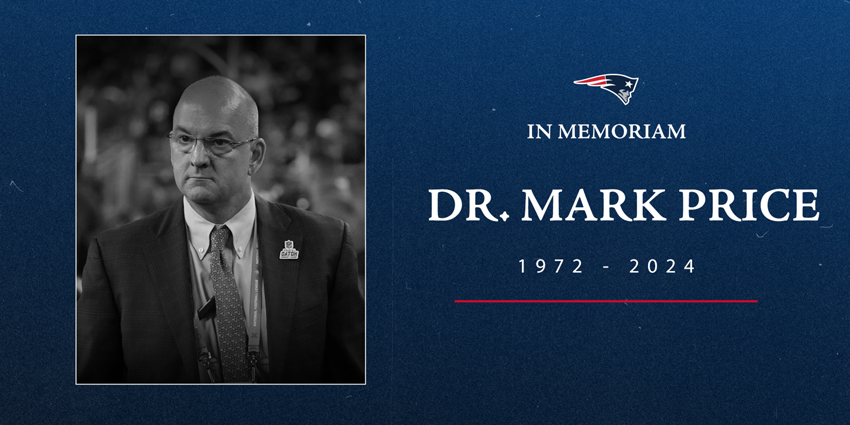
Sports medicine orthopedic surgeon and long-time New England Patriots team physician and medical director Mark Price, M.D., Ph.D., died this past week. He was 52 years old.
Mark Price, M.D., Ph.D., NE Patriots Team Doctor Dies, Age 52
2 min read Premium comments
Remembrances#obituary#markprice
The NFL team announced on Aug. 18 that Price died of cancer. Price served the Patriots since 2016, during which time the franchise has won two Super Bowls.
“His contributions to the health and well-being of our players were invaluable, and his commitment to excellence was evident in every aspect of his work,” the Patriot’s CEO Robert Kraft said in a letter.
Price was a board-certified orthopedic surgeon at the Massachusetts General Hospital, where he specialized in sports medicine shoulder surgery. He performed arthroscopic surgery of the shoulder, as well as total shoulder replacement and complex shoulder reconstructions, according to a staff biography.
Before he joined the New England Patriots, Price was a team physician for the Boston Red Sox.
Prior to Mass General, he worked at the UMass Medical School and UMass Memorial Medical Center in Worcester where he helped establish a comprehensive shoulder program.
Price conducted research dedicated to better understanding the impact of various sports-related injuries (shoulder, knee, hamstring, concussion, etc.) on patient health and well-being.
Career Highlights
- Earned his M.D. from Harvard Medical School and Ph.D in Medical Physics from Massachusetts Institute of Technology.
- Completed the Harvard Combined Orthopaedic Residency Program where he was the Administrative Chief Resident at Mass General. He won both resident and faculty teaching awards.
- Completed a fellowship in sports medicine and shoulder reconstructive surgery at Mass General, where he was awarded the Herodicus Society traveling fellowship and studied with Dr. Jim Andrews at the American Sports Medicine Institute in Birmingham, Alabama, and Dr. David Altchek at the Hospital for Special Surgery in New York.
- Faculty of Harvard Medical School where he was an Assistant Professor teaching in the anatomy and pathology courses.
- Captain in the U.S. Navy Reserves and served in combat operations in Afghanistan, where he was awarded the Bronze Star Medal.
- Fellow of the American Academy of Orthopedic Surgery, Arthroscopy Association of North America, American Orthopedic Association, and the American College of Surgeons.
Member of the American Orthopaedic Society for Sports Medicine, Society of Military Orthopedic Surgeons, American Shoulder and Elbow Surgeons, and New England Shoulder and Elbow Society.
Author
React:
Discussion
This is a fascinating development. In my practice we've seen similar outcomes with the revised protocol. The key differentiator seems to be patient selection criteria. Has anyone else noticed the correlation with BMI thresholds?
Great point. I'd push back slightly on the conclusion, the sample size in the cited study is too small to draw population-level inferences. That said, the directional signal is compelling and worth a larger RCT.
We implemented a similar approach last year. Early results are promising but we're still gathering 12-month follow-up data. Happy to share our protocol if anyone is interested.
Join the conversation
Orthopedic professionals are discussing this. Sign in and upgrade to read every comment and add your voice.