
The U.S. Food and Drug Administration (FDA) has granted 510(k) clearance to a new, integrated, lumbar (3D printed) interbody fusion system for anterior spine surgery indications.
FDA Clears Camber Spine’s New Anterior Integrated System
2 min read Premium comments
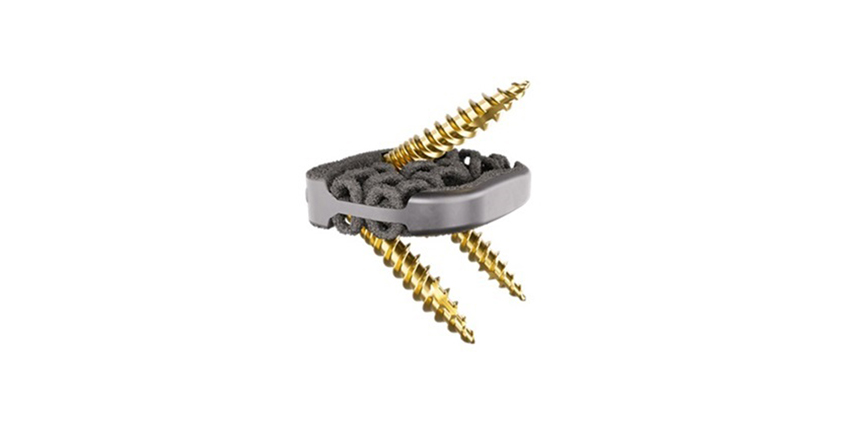
Secondary#camberspine#spiraanteriorlumbarspacers
According to the FDA’s 510(k) summary document, this new device, brand-named SPIRA-A anterior lumbar spacer is cleared for commercialization and “indicated for use at one or more levels of the thoracic spine (T1-T12), thoracolumbar junction (T12-L1), or lumbosacral spine (L1-S1) as an adjunct to fusion in patients with the following indications: degenerative disc disease (DDD), disc herniation (with myelopathy and/or radiculopathy), spondylolisthesis, deformity (degenerative scoliosis or kyphosis). spinal stenosis and failed previous fusion (pseudarthrosis).”
Additionally, the SPIRA-A is “intended to be used with additional FDA-cleared supplemental fixation systems.” Furthermore, the spacers system “must be used with autogenous or allogenic bone graft composed of cancellous and/or corticocancellous bone graft.”
Furthermore, SPIRA-A is also indicated for “one or more levels from L1-S1 as an adjunct to fusion in skeletally mature patients with the following indications: degenerative disc disease (DDD), disc herniation (with myelopathy and/or radiculopathy) spondylolisthesis, deformity (degenerative scoliosis or kyphosis), spinal stenosis and failed previous fusion (pseudarthrosis).” The integrated fixation system spacers “must be used with autogenous bone graft or allogenic bone graft composed of cancellous and/or corticocancellous bone graft.”
Camber Spine Technologies, based in King of Prussia, Pennsylvania, is the manufacturer and will be featuring the new Camber SPIRA® Anterior Lumbar Spacers at the upcoming North American Spine Society annual meeting.
Camber Spine CEO Brooks McAdam said, “The FDA’s 510(k) clearance of our SPIRA-A Integrated technology ushers in the next evolution in our innovative SPIRA platform and marks another major step forward in our company’s development.”
McAdam continued, “It also helps bring more innovation-based solutions and options to the surgical community and a solution for surgeons engaging or wanting to engage in the ALIF market. We believe SPIRA Technology, which encompasses the structure, surface, and science behind our 3D-printing process, is the archetypal design for modern spine implants and exemplifies the true benefits of additive manufacturing.”
Camber Spine’s SPIRA implants are 3D printed, which, according to Camber, “creates unique patented structures featuring open arched matrices and proprietary surfaces designed to enhance fusion and promote bone growth.”
A device must be substantially equivalent to a predicate device to qualify for shorter and earlier 510(k) clearance. According to the 510(k) summary document the anterior lumbar spacers are substantially equivalent to the following primary predicate device by Camber Spine Technologies: SPIRA® Open Matrix ALIF. Also per the 510(k) summary document, the integrated fixation system is “most similar in design and indications for use to the predicate Globus Medical HEDRON IA and CORBEL spacers.”
Author
React:
Discussion
This is a fascinating development. In my practice we've seen similar outcomes with the revised protocol. The key differentiator seems to be patient selection criteria. Has anyone else noticed the correlation with BMI thresholds?
Great point. I'd push back slightly on the conclusion, the sample size in the cited study is too small to draw population-level inferences. That said, the directional signal is compelling and worth a larger RCT.
We implemented a similar approach last year. Early results are promising but we're still gathering 12-month follow-up data. Happy to share our protocol if anyone is interested.
Join the conversation
Orthopedic professionals are discussing this. Sign in and upgrade to read every comment and add your voice.