
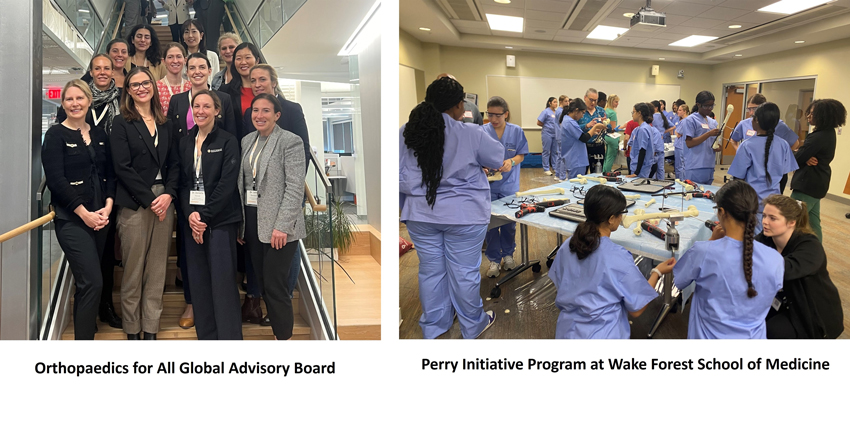
Orthopaedics for All, a new global advisory board, is amplifying the voice of women in orthopedic surgery.
New Ortho Global Advisory Board Serves Female Leaders
2 min read Premium comments
Smith NephewSecondary#orthopaedicsforall
The advisory board was established by global medical technology company Smith+Nephew. The board was created to, said the company, “amplify diversity by building equity, break biases, and inspire inclusion for individuals wishing to pursue a career in orthopedic surgery.”
The board was created in response to the staggering low number of women in the field of orthopedic surgery. According to the advisory board, “multiple studies” provide clear, empirical evidence that ”only 15% of all orthopedic residents were women and just 7.4% were practicing orthopedic surgeons in the United States during 2022.”
Of course, the reverse statistics are 85% of all orthopedic residents are men and 83.6% of all practicing orthopedic surgeons are men. Nothing wrong with men. But, ironically, the majority of orthopedic patients are women. More representation from women would more closely match the demographics of the typical ortho and spine patient.
This difference between the number of women and men who choose orthopedics as a profession may be due to a number of factors. Those cited in the announcement include “greater vulnerability to work-family conflict, less supportive references than their male counterparts, and less national research funding compared to men.” These inequities are some of the many challenges that Smith+Nephew is targeting with this new advisory board.
While the field of orthopedics may be disproportionately represented by men, that does not mean that it lacks for female leaders. The board is evidence of this with its leadership team from across the globe comprised of 20 female leaders and surgeons from the adult hip and knee orthopedic reconstruction segment. Members of the advisory board must have at least two years post-fellowship experience in reconstructive surgery, as well as “a mix of both academic and private practice experience, and an interest in gender diversity and inclusion initiatives.”
Smith+Nephew Chief Human Resource Officer Elga Lohler explained, “There is meaningful data that supports the case for increased diversity within medicine and more broadly the medical device industry. Diversifying our work force is not just critical to improving employee engagement and retention, which directly impacts business growth and profitability, but diversity in medicine can also help reduce health care disparity and improve patient outcomes.”
Lohler continued, “Our Orthopaedics for All global advisory board has been established to truly understand the needs of a more diverse customer group, so that we can build sustainable strategies that address rapidly evolving customer needs.”
Author
React:
Discussion
This is a fascinating development. In my practice we've seen similar outcomes with the revised protocol. The key differentiator seems to be patient selection criteria. Has anyone else noticed the correlation with BMI thresholds?
Great point. I'd push back slightly on the conclusion, the sample size in the cited study is too small to draw population-level inferences. That said, the directional signal is compelling and worth a larger RCT.
We implemented a similar approach last year. Early results are promising but we're still gathering 12-month follow-up data. Happy to share our protocol if anyone is interested.
Join the conversation
Orthopedic professionals are discussing this. Sign in and upgrade to read every comment and add your voice.