
Arthrex, a company focus on minimally invasive surgical technology, was recently honored with two of its innovations named finalists for the international Edison Awards. Now in its 37th year, the annual awards ceremony recognizes businesses, executives and inventors from around the world who have created innovative products and services that not only solve problems, but also seize opportunities to create new markets. Former recipients include Ted Turner, Elon Musk, and Steve Jobs.
Arthrex Innovations: Finalists for 2024 Edison Awards
3 min read Premium comments
#kneearthroplastySecondary#arthrex#meniscalrootrepair#softanchor
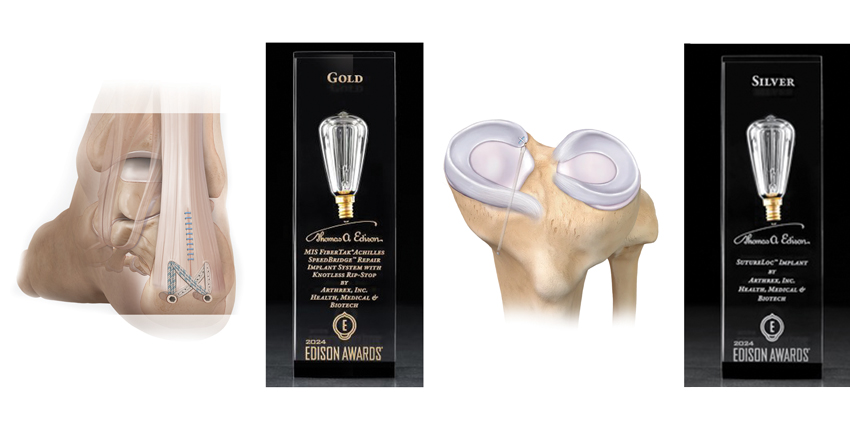
Arthrex was nominated for the SutureLocTM implant, the first knotless, retensionable soft anchor designed for arthroscopic meniscal root repair. The all-suture soft anchor is designed for retrograde insertion directly under the repair subcortically, improving fixation strength and stiffness by eliminating suture fixation devices in the anterior tibia.
The Product Manager for Knee Arthroscopy, Julia Cuny, told OTW, “Meniscus root repair is a technically complicated surgery in the posterior aspect of the knee. Ten to 15 years ago, root repairs were not typically addressed, which can have catastrophic consequences on patients’ knees and can lead to rapid cartilage degeneration. The first techniques to market borrowed implants that were designed for other pathologies. These techniques achieve better patient outcomes; however, meniscus root repair still saw high failure rates. Arthrex designed the SutureLoc™ implant to address these failures and to achieve better patient outcomes.”
When OTW asked how they eliminated the need for a posterior medical portal, Cuny noted, “Due to the large distance between the repair site and fixation, surgeons began using suture anchors for direct tibial fixation. These anchors were pushed into the bone during procedures, requiring posterior portals, which can be difficult and dangerous to patients. To eliminate the use of the posterior portal in repairs, Arthrex focused on achieving joint line fixation by pulling the implant through a transtibial bone tunnel, making the repair more familiar and reproducible to surgeons.”
The MIS FiberTak® Achilles SpeedBridgeTM repair implant system with Knotless Rip-Stop was also nominated for an award in the Surgical Innovations category. This system provides a minimally invasive approach for insertional Achilles tendinopathy and allows for a percutaneous approach using a knotless rip-stop and 1.7 mm collagen coated FiberTape in an hourglass pattern of opposition and compression to the bone.
Regarding the MIS FiberTak Achilles SpeedBridge, OTW asked Pete Denove, Senior Director of Product Management, Extremities & Trauma, why he thinks such a product hasn’t reached the market before now. “Since the launch of the original open SpeedBridge™ technique 13 years ago, minimally invasive surgical approaches have been on the rise. It’s a natural evolution that the open procedure moved to more of a minimally invasive technique. The addition of FiberTak® soft anchors increased the suture footprint proximally, creating a stronger repair. This combined with four small incisions (instead of a one large one) makes for a technique that surgeons will rally around to support better patient care.”
As for how the hourglass pattern facilitates things, Denove commented, “The hourglass pattern (narrows proximally with the body of the Achilles tendon) mimics the anatomy of the Achilles as it flares or spans out distally. Since the bony prominence is removed proximally and it’s important to get solid fixation with the FiberTak anchors and the ripstop, it looks like the narrow part of the hourglass at the top and flares out to get the largest footprint distally, where the SwiveLock® anchors require solid fixation in the distal portion of the calcaneus.”
Arthrex previously won three Edison Best New Product gold awards for OrthoPedia, the InternalBraceTM 2.0 ligament augmentation repair system and for Nano arthroscopy along with a bronze award for its Minimally Invasive Bunionectomy procedure.
Author
React:
Discussion
This is a fascinating development. In my practice we've seen similar outcomes with the revised protocol. The key differentiator seems to be patient selection criteria. Has anyone else noticed the correlation with BMI thresholds?
Great point. I'd push back slightly on the conclusion, the sample size in the cited study is too small to draw population-level inferences. That said, the directional signal is compelling and worth a larger RCT.
We implemented a similar approach last year. Early results are promising but we're still gathering 12-month follow-up data. Happy to share our protocol if anyone is interested.
Join the conversation
Orthopedic professionals are discussing this. Sign in and upgrade to read every comment and add your voice.