
This is a truly novel SI Joint fixation design.
510(k) Clearance for a ‘BowTie’ SI Joint Fixation Device
1 min read Premium comments
Secondary#sailfusion#auroraspine#bowtie#silotfx
And the U.S. Food and Drug Administration (FDA) has granted 510(k) clearance to its “BowTie” designed sacroiliac fusion system.
According to the FDA 510(k) summary document, the novel sacroiliac joint (SI) fusion system is “intended to provide stabilization of the sacroiliac joint until fusion occurs.” It includes an implant and a set of ancillary instruments. The implant is comprised of an “interarticular component, an iliac screw, and a transfix screw.”
Again, referring to the FDA summary document, the BowTie is indicated for “sacroiliac joint fusion for conditions including sacroiliac joint disruptions and degenerative sacroiliitis.” When the system is implanted, “both the iliac and transfix screw components must be used.”
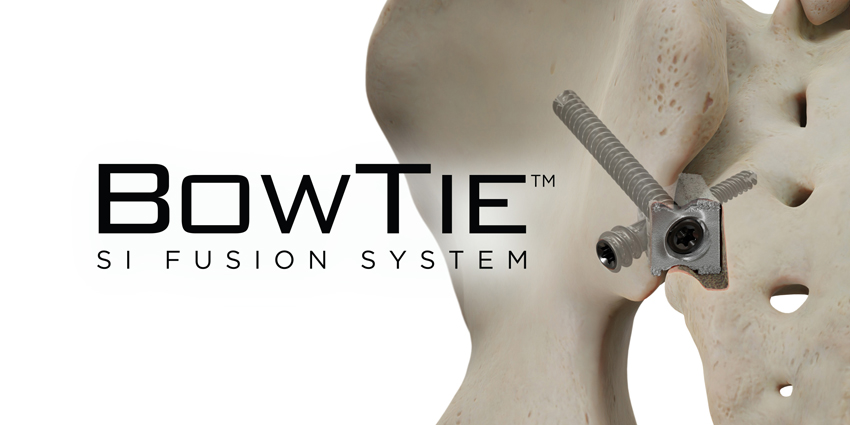
It looks like a BowTie and it is brand named, BowTie™ SI Joint Fusion System. SAIL Fusion, LLC submitted the 510(k) application. According to the company, BowTie™ “is the first SI fusion technology to be based on long-standing, validated joint fusion principles established by the AO Foundation and is now the sole commercially available device that incorporates both intra‑articular and transfixing components.”
SAIL Fusion President and CEO David Jansen explained to OTW, “The BowTie device, with its trademark bowtie shape, was designed to help achieve the AO’s other significant joint fusion principle of rigidly fixating the joint to provide a biologic environment favorable for bone growth. We reinforced its rigidity by adding both integrated iliac and transfixation screws to address the complex biomechanics of the pelvis.”
Jansen continued, “We are pleased that BowTie’s multiplanar approach to fixating the joint also closely aligns with both the Transfixation and the recently established Intra-Articular CPT codes. This is an exciting time for surgeons, and especially for patients struggling with chronic SI joint pain.”
The primary predicate device for BowTie’s clearance was the SILO TFX MIS Sacroiliac Joint Fixation System by Aurora Spine, Inc. According to the 510(k) summary document, the device is substantially equivalent to the primary predicate device “in all facets including function, design, performance, material, and intended use.”
Author
React:
Discussion
This is a fascinating development. In my practice we've seen similar outcomes with the revised protocol. The key differentiator seems to be patient selection criteria. Has anyone else noticed the correlation with BMI thresholds?
Great point. I'd push back slightly on the conclusion, the sample size in the cited study is too small to draw population-level inferences. That said, the directional signal is compelling and worth a larger RCT.
We implemented a similar approach last year. Early results are promising but we're still gathering 12-month follow-up data. Happy to share our protocol if anyone is interested.
Join the conversation
Orthopedic professionals are discussing this. Sign in and upgrade to read every comment and add your voice.