
“Voted off the island” and “voted out of the tribe” are familiar sayings in the reality TV arena. But in the real world, whether someone is intentionally excluded or cannot participate in community activities, the resulting isolation, inability to earn a living or go to school—not to mention the accompanying psychological damage—take their toll.
Steps2Walk: Enriching Generations Via Surgery and Education
6 min read Premium comments
#anishkadakia#humanitariansurgicalmission#markmyerson#steps2walk
Who is excluded? Millions of people around the world. Why? Because they cannot walk—or they walk despite severe foot and ankle deformities.
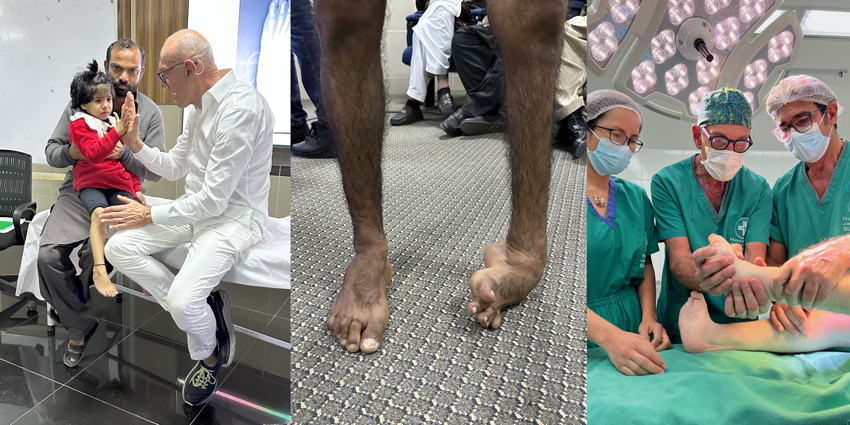
To begin to turn the tide for those with disabling foot and ankle injuries, Steps2Walk, a global humanitarian nonprofit, is making concrete, sustainable strides in bringing relief, hope, and orthopedic education to underserved areas of the world.
Founder Mark Myerson, M.D., a visiting professor of foot and ankle surgery at The University of Colorado Anschutz Medical Campus, told OTW, “When we started in 2000, it soon became clear that although humanitarian trips are helpful for a certain number of people, Steps2Walk could have a much bigger impact if we were to train hundreds of surgeons so they could go forth and ultimately help thousands of patients.”
Twenty-four years later, Steps2Walk has trained more than 600 surgeons annually and performed over 1,700 operations in 24 countries.
Reanimating Entire Communities
Anish Kadakia, M.D., a veteran of Steps2Walk’s life-changing programs, is a foot and ankle surgeon at Northwestern University Feinberg School of Medicine in Chicago. “Eighteen years ago, I was Mark Myerson’s fellow,” says Dr. Kadakia. “Upon hearing him lecture on Steps2Walk’s cases and impact—including their not-so-common dedication to orthopedic education—I was fascinated.”
Now, having participated in three trips, Dr. Kadakia lauds the organization’s multiple benefits. “First of all, when we perform surgery in America, for the most part we are making people somewhat better. When operating in impoverished areas around the globe, however, you make a vast difference. These surgeries can ultimately reanimate whole communities as they give people the opportunity to participate in society. As it is now, these children can’t walk to school and adults cannot walk to work, creating massive downstream economic and psychological problems.”
“As opposed to a fly-in fly-out model, Steps2Walk does not leave a wasteland of complications behind. We work with local surgeons, return to the same place annually, and the local surgeons have continual access to the medical team via WhatsApp throughout the year.”
Medicine at its Purest and Best
“Our goal for each program is that they do their best to follow up with patients and communicate that progress with us, though it can sometimes be impossible due to how far some patients have to travel for care. We strive to go back to each country regardless of circumstances as we believe with each program, the coordination and communication with local hosts will become more efficient. Flexibility, on our part and that of the local hospitals, is key. The ultimate goal of a mission is to train local surgeons to the point where Steps2Walk is no longer needed in their community.”
“Second, Steps2Walk missions take medical professionals away from the rigamarole and administrative burden we deal with every day. There is a genuine joy that we all feel when helping these patients…this is pure medicine.”
The third reason Dr. Kadakia is a proponent of Steps2Walk is intellectual. “When I first encountered an extremely complex case on a trip, I literally had no idea how to help the person, a young man of 22 who was born with one of his feet facing backwards. This type of congenital deformity doesn’t occur in the U.S., and this was an opportunity for me to learn from surgeons who had participated in prior mission trips.”
Sustainability Is the Mantra
Dr. Myerson, who participates in 1-2 mission trips per month, explained the details of this kind of medical practice, “We see a good deal of patients with congenital conditions, while others have injuries resulting from trauma or previous injuries that were not adequately treated at the time. We may encounter patients with spina bifida, arthritis, high arches, club foot deformities, and other foot and ankle conditions that affect their quality of life and ability to walk.”
“Our foundational mantra is ‘sustainability,’” adds Dr. Myerson. “Continuity of care is about ongoing education, which is where the Steps2Walk Global Institute plays a vital role. I’ve just returned from Pakistan where we had 48 surgeons who had come from all around the country. We also included residents because we want people trained as early as possible. This is critical because Pakistan, a country of 223 million people, doesn’t have a single fellowship-trained foot and ankle surgeon.”
With a network of more than 250 surgeon volunteers from around the globe, including 125 who regularly participate, Steps2Walk is growing in popularity. “Next week we will be in Tanzania, another country without any foot and ankle surgeons. We will be welcoming now only Tanzanian surgeons but also several from Uganda and Kenya. While we are so appreciative of our member surgeons, we would love to welcome new members.”
The Biggest Challenges
OTW asked Dr. Myerson to describe the biggest challenges that new surgeons experience as they come onboard. “Surgeons are often intimidated by the type of work we do as 50% of the surgeries involve deformities no longer seen in the Western world,” Myerson explained. “But as Anish Kadakia and many others have done, they can push past that and have unforgettable experiences on our team. In recruiting new surgeon volunteers, we determine if they have special language or surgical skills. It’s not all about the surgery…if I take a brilliant surgeon on a trip, but that person can’t teach and can’t communicate then I have failed.”
In order to deliver the most impact, says Dr. Myerson, it is important to focus on teaching the local surgeons how to contend with things such as ankle fractures, flatfeet, and arthritis. “It is imperative that we teach what is useful and only bring equipment that meets their needs, i.e., is not fancy and is sustainable.”
“Surgeons who participate in our trips come home enriched, gratified, and feeling blessed by the opportunity they were given. They have helped beyond measure, had an unusually fulfilling orthopedic experience—as surgeons and educators—and have garnered lifelong friendships with the international faculty as well as the local orthopedic population.”
Money and Donations
Regarding donations, things have advanced since the organization’s early days, when, says Dr. Myerson, they would pack surgical equipment in their suitcases and hope for the best. “We don’t have too much of a struggle acquiring equipment donations…the bigger issue is that some countries won’t allow us to bring any instruments or other supplies. This involves a lot of negotiation.”
Indeed, to start up in a new country it takes roughly two years to plan. “We need surgeons on the ground who will function as hosts, and we need a local hospital with the appropriate infrastructure. We may want three ORs, but if it’s a remote hospital with only four ORs then it’s not easy for them to make that commitment. Then of course the local surgeons have to make a plan to find patients, and ‘market’ to surgeons in their region.”
Sustainability of such sweeping undertakings calls for continuous funding. “We have recently launched our ‘Stepping Together’ campaign in conjunction with our orthopedic industry partners. If a company donates $50,000 and then matches employee donations, then that becomes a powerful multiplier. It not only sends a message that the company is philanthropically inclined, but it spreads the word about the Steps2Walk mission.”
“The enormous and concrete advances that these patients make are astounding,” states Dr. Kadakia. “After surgery, they can go to school, walk, get a job, and participate in society. Seeing how much people can tolerate has been eye opening. I have seen children running and smiling with an equinus deformity of 70 degrees! Working with Steps2Walk has made me a better surgeon and a better human being. I can’t wait for my next trip.”
In 2023, Steps2Walk conducted 11 missions to underserved regions around the world, including to countries where foot and ankle orthopedic surgeons are scarce or non-existent. Their team of volunteer surgeons treated 165 patients and provided essential training to 260 local surgeons in 2023.
In 2024, Steps2Walk is planning on visiting 17 countries, including Sri Lanka, Pakistan, Mexico, Philippines, Namibia, Tanzania, Kenya, Chile, Argentina, Brazil, Peru, Bolivia, China, Honduras, India, and Uruguay.
For additional information on the Steps2Walk programs, please visit:
Author
React:
Discussion
This is a fascinating development. In my practice we've seen similar outcomes with the revised protocol. The key differentiator seems to be patient selection criteria. Has anyone else noticed the correlation with BMI thresholds?
Great point. I'd push back slightly on the conclusion, the sample size in the cited study is too small to draw population-level inferences. That said, the directional signal is compelling and worth a larger RCT.
We implemented a similar approach last year. Early results are promising but we're still gathering 12-month follow-up data. Happy to share our protocol if anyone is interested.
Join the conversation
Orthopedic professionals are discussing this. Sign in and upgrade to read every comment and add your voice.