
The average of five years of consulting payments to orthopedic and spine surgeons was $57,000, but the average for recon surgeons was $225,000 and for spine surgeons was $197,000.
Average 5-yr Ortho Surgeon Consulting Fee Was $57k, But…
2 min read Premium comments
#centersforMedicareandmedicaidservices#cureus#openpaymentsdatabase
These data came from an analysis of five years of consulting payments to orthopedic surgeons which was published in Cureus Journal of Medical Science.
The study is titled “Industry Payments to Orthopedic Surgeons Among All Subspecialties: An Analysis of the Open Payments Database From 2014 to 2019.”
The purpose of the study was to examine trends in payments made to orthopedic surgeons during that time period. The study analyzed the different types of industry payments and the differences between the orthopedic subspecialties. According to the study, “a total of 1,048,573 payments (approximately $1.6 billion) were made to orthopedic surgeons between 2014 and 2019.”
The data for the study came from a review of the Centers for Medicare and Medicaid Services (CMS) Open Payments Database (OPD). The sample included the following orthopedic subspecialties:
- general orthopedic surgeons;
- sports medicine surgeons;
- orthopedic hand surgeons;
- orthopedic spine surgeons;
- adult reconstructive orthopedic surgery;
- orthopedic foot and ankle surgeons;
- orthopedic trauma surgeons; and
- pediatric orthopedic surgeons.
Orthopedic oncologists and shoulder and elbow orthopedic surgeons were not included in the study.
The study found that the “mean of total payments made to orthopedic surgeons was $56,794.88.”
Furthermore, on average, the greatest total payments are being made to adult reconstructive orthopedic surgeons followed by orthopedic spine surgeons. These surgeons received “significantly greater mean individual payments when compared to all other subspecialties.”
The mean total industry payments for adult reconstructive orthopedic surgeons was $225,131.10. The mean total industry payments for orthopedic spine surgeons was $197,404.74. By contrast, mean total payments for orthopedic hand surgeons was $14,027.76 and mean total payments for general orthopedic surgeons was $28,405.81.
The sample also included information on the following payment types:
- faculty/speaker fees;
- consulting fee;
- ownership/investment;
- education;
- entertainment, food, and beverage;
- royalty/license; and
- travel and lodging.
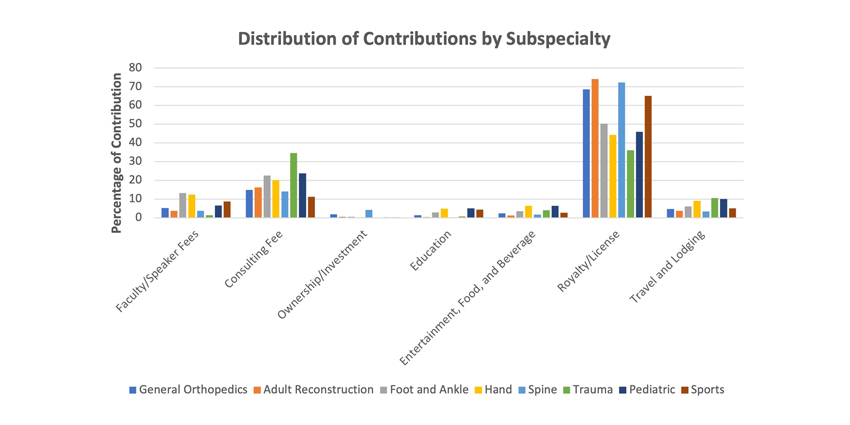
The analysis revealed that there was a “statistically significant interaction between payment type and orthopedic subspecialty.”
Notably, royalties or licensing encompassed the “greatest proportion of open payments for all orthopedic subspecialties.” According to the study, the majority of payments made to the following subspecialties came from royalties or licensing:
- “adult reconstructive surgeons (74.19%),
- orthopedic spine surgeons (72.34%),
- general orthopedic surgeons (68.68%),
- sports medicine surgeons (65.08%), and
- foot and ankle surgeons (50.21%).”
The next most significant payment type was consulting fees. The other payment types “contributed to less than 10% of open payments made to all subspecialties.”
Author
React:
Discussion
This is a fascinating development. In my practice we've seen similar outcomes with the revised protocol. The key differentiator seems to be patient selection criteria. Has anyone else noticed the correlation with BMI thresholds?
Great point. I'd push back slightly on the conclusion, the sample size in the cited study is too small to draw population-level inferences. That said, the directional signal is compelling and worth a larger RCT.
We implemented a similar approach last year. Early results are promising but we're still gathering 12-month follow-up data. Happy to share our protocol if anyone is interested.
Join the conversation
Orthopedic professionals are discussing this. Sign in and upgrade to read every comment and add your voice.