
What does freedom look like? For millions who’ve lost or never had the freedom to roam on their own power, freedom may well be this first-of-its-kind 32 lbs. of stainless steel.
A Unique Free-Standing Walker Delivers Freedom to Roam
3 min read Premium comments
#adultindependencewalker#chiarisyndrome#freedomtoroam#incompletequadriplegic
The Freedom to Roam, a walker-like device, was created by Robert “Lewy” Lewis, a self-made entrepreneur and incomplete quadriplegic.
Calling himself a “farm boy” Lewy says when he couldn’t keep up with his farm tasks, his father thought he was lazy. “It turns out I have a condition called Chiari syndrome, a situation where the brain tissue extrudes into the spinal canal. I was just exhausted all the time.”
At the age of just 21 years, Lewy had surgery to remove eight inches of his vertebrae. “That was 1974—before MRIs—and the doctors weren’t really equipped to handle my condition.”
Lewy lived in chronic pain for years.
Fast forward to 2006. “I was doing alright and had just bought a company. I scheduled a surgery to remove scar tissue and was only supposed to be in the hospital for a week, but I ended up with postoperative bacterial meningitis. I became an incomplete quadriplegic, meaning that I lost the functionality of my arms and hands, but my legs still work; balancing my body weight is something that became a huge challenge.”
For the next 15 years, Lewy would have to rely on others to assist him with daily tasks and exercise.
Then came the dreams.
“I began having a recurring dream of a special kind of walker…the dream even contained the instructions!”
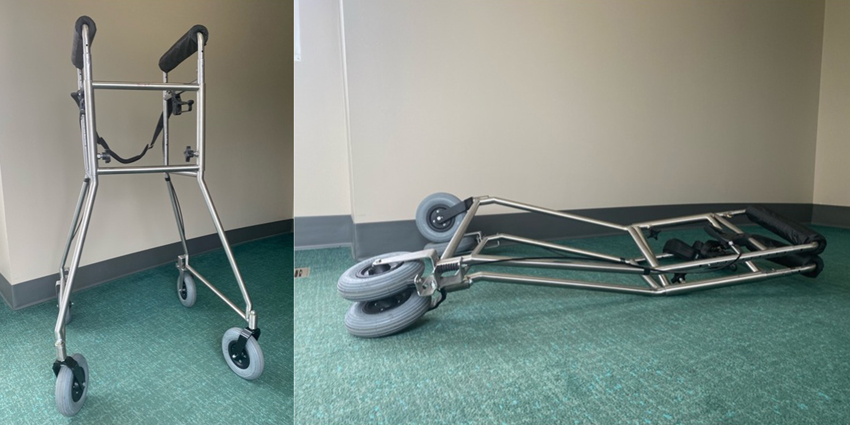
Lewy contacted an engineer friend, who developed the first prototype of the Adult Independence Walker in 2020. “There was nothing like this on the market—a lightweight, stand-up, walker-like device that could easily be used at home or out and about—and do them [tasks] without assistance.”
“One feature that offers extra support and confidence to users is that we designed it to be vertically and horizontally tapered, i.e., narrower at the top, both in width and depth, which adds stability.”
Thrilled with the initial prototype, Lewy tested the Freedom to Roam each day. “The change in my life has been dramatic. For the first time in over 15 years, I have been able to exercise and do daily tasks without anyone’s help.”
Wheelchair-free for three years, Lewy credits his device for helping to maintain and build strength in his legs. “I didn’t want to keep the Freedom to Roam to myself as it was obvious that it held the potential to aid people with multiple conditions, include obese individuals, stroke survivors, amputees, Parkinson’s patients, as well as those with other conditions.”
Such was the case with a young lady of 19 contending with cerebral palsy. “She had been in a wheelchair her entire life. Surrounded by her mother and father, using the Independence Walker, she was able to ambulate on her own. We all cried that day!”
Then there was the stroke survivor whose legs hadn’t worked in over a year. “He initially struggled because his legs were completely deconditioned. He paused and when he tried again, he was able to walk on his own for 20 minutes…we had to get him to stop!”
Now capable of producing 10-15 walkers each day, Freedom to Roam stands alone as the only such device to provide support through the user’s core that is made in a collapsible configuration. And because the Independence Walker is classified as a rehabilitative device as opposed to a walker, it can be covered under insurance plans.
The Independence Walker’s large diameter pivoting wheels mean that rolling over uneven floors or gaps in tile are no problem. The armpit braces are height-adjustable, and the side panels are width-adjustable to accommodate various body sizes. The patent-pending Adult Independence Walker by Freedom to Roam is manufactured in the United States.
To learn more, please contact Freedom to Roam, LLC at F2R.standup.walker@gmail.com or visit http://FreedomToRoamWalker.com/
Author
React:
Discussion
This is a fascinating development. In my practice we've seen similar outcomes with the revised protocol. The key differentiator seems to be patient selection criteria. Has anyone else noticed the correlation with BMI thresholds?
Great point. I'd push back slightly on the conclusion, the sample size in the cited study is too small to draw population-level inferences. That said, the directional signal is compelling and worth a larger RCT.
We implemented a similar approach last year. Early results are promising but we're still gathering 12-month follow-up data. Happy to share our protocol if anyone is interested.
Join the conversation
Orthopedic professionals are discussing this. Sign in and upgrade to read every comment and add your voice.