
LifeNet Health has filed a lawsuit against Zimmer Biomet Holdings, Inc. (Zimmer) and Embody, Inc. alleging patent infringement and tortious interference over the novel TAPESTRY Biointegrative Implant which Zimmer acquired for $155 million at closing and another $120 million in milestone payments.
LifeNet Health Sues Zimmer Biomet & Embody for Patent Infringement
2 min read Premium comments
#zimmerbiomet#lifenethealth#activbraid#embody#tapestry
LifeNet Health and Embody, Inc. are both located in Virginia, just 16 miles apart.
LifeNet is a non-profit, global leader focused on regenerative medicine and life sciences based in Virginia Beach, Virginia. The litigation involves two allegedly former LifeNet employees: Michael P. Francis, Ph.D. and Nathan Kemper, M.S.
The litigation also involves two LifeNet patents: U.S. Patent Number 10,137,223 (the ’223 Patent) and U.S. Patent Number 11,318,227 (the ’227 Patent). Dr. Francis and Roy Ogle are named inventors for both patents. Both patents are titled “Aligned Fiber and Method of Use Thereof.”
According to the complaint, LifeNet claims that Dr. Francis and Kemper were both employed by LifeNet and were subject to employment and intellectual property agreements. LifeNet claims that when Embody was founded it almost “immediately began poaching LifeNet’s locally based research team to develop its own tissue implants using LifeNet’s patented technology.”
LifeNet alleges that Embody hired Dr. Francis and promoted him to chief scientific officer and that, “almost immediately, Embody began utilizing LifeNet’s patented electrospinning technology to develop its own implants for treating soft-tissue injuries.” LifeNet also claims that Kemper left LifeNet for Embody.
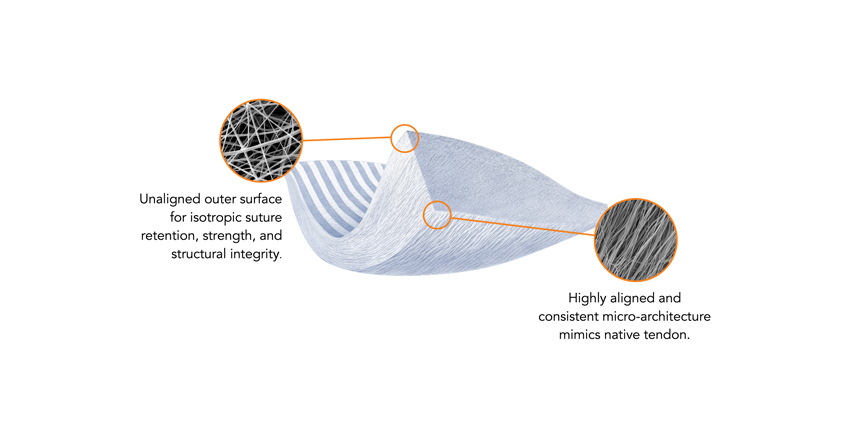
According to LifeNet’s complaint, beginning in 2017, “Embody began filing its own patents on collagen-based products that incorporated LifeNet’s patented technology.” LifeNet alleges that “by unlawfully using LifeNet’s patented inventions, Embody ultimately arrived at the TAPESTRY Biointegrative Implant (TAPESTRY).” LifeNet cites Embody in the complaint, explaining that “TAPESTRY ‘is a bioengineered collagen implant with a highly aligned & highly porous architecture specifically designed to support tendon and ligament healing.’”
LifeNet further asserts that Embody has also “been using LifeNet’s patented technology in the ActivBraid Collagen Suture.” LifeNet cites Embody in the complaint, explaining that “ActivBraid uses a ‘novel cross-linking’ that has ‘no associated inflammatory response.’” LifeNet maintains that “just as with LifeNet’s ’227 Patent, ActivBraid uses highly aligned, crosslinked collagen microfibers.”
Zimmer acquired Embody earlier this year and is also listed as a defendant in the lawsuit. For OTW’s coverage of the acquisition, see “Zimmer Biomet Buys Sports Med Innovator Embody.” LifeNet argues that the basis for the purchase was Embody’s portfolio which solely consisted of the two allegedly infringing product lines.
LifeNet is asserting two counts of patent infringement and one count of tortious interference with contract. In its prayer for relief, LifeNet is requesting judgment in its favor, damages, and that the court transfer ownership of Embody patents and patent applications “developed by Dr. Francis and Mr. Kemper while they were LifeNet employees.”
Author
React:
Discussion
This is a fascinating development. In my practice we've seen similar outcomes with the revised protocol. The key differentiator seems to be patient selection criteria. Has anyone else noticed the correlation with BMI thresholds?
Great point. I'd push back slightly on the conclusion, the sample size in the cited study is too small to draw population-level inferences. That said, the directional signal is compelling and worth a larger RCT.
We implemented a similar approach last year. Early results are promising but we're still gathering 12-month follow-up data. Happy to share our protocol if anyone is interested.
Join the conversation
Orthopedic professionals are discussing this. Sign in and upgrade to read every comment and add your voice.