
The U.S. Food and Drug Administration (FDA) has granted 510(k) clearance to an augmented reality spine system for spinal procedures.
FDA Clears Novel Augmented Reality Spine System
2 min read Premium comments
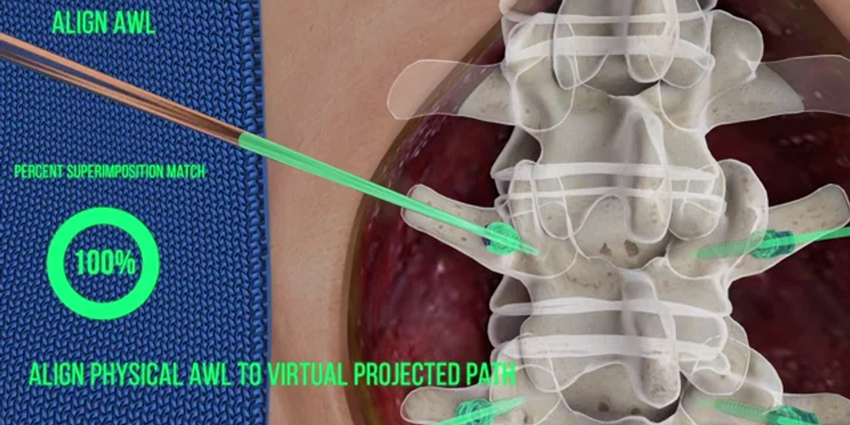
#augmedicsxvision#onpointaugmentedreality#onpointsurgical
According to the 510(k) summary document, the augmented reality spine system consists of the following components:
- Tracking camera, workstation, and cart
- Headsets with supplemental battery
- Software
- Tracked instruments and adapters
According to the FDA’s 510(k) summary document, the augmented reality spine system, in conjunction with its software, is intended as “an aid for precisely locating anatomic structures in either open or percutaneous spine procedures.” Its use is “indicated for any medical condition in which the use of stereotactic surgery may be appropriate, and where reference to a bony anatomical structure, such as the spine or pelvis, can be identified relative to CT images of the anatomy.”
This can include “spinal implant procedures, such as pedicle screw placement, where the surgeon wants to see a tracked instrument location in relationship to the stereotaxic display of the CT images of the anatomy.”
Additionally, the optical head mounted display of the systems “displays 2D stereotaxic screens and an optional virtual anatomy screen, paired with optional graphical targeting tools and alphanumeric displays.” The stereotaxic screen is indicated for “correlating the tracked instrument location to the registered patient images.”
The virtual screen is indicated for “displaying the virtual instrument location in relation to the virtual anatomy to assist in percutaneous visualization and trajectory planning.” The graphical targeting tools and alphanumeric display are indicated for “providing visual and quantitative tracking information of the tracked instrument location including deviation from plan.”
The virtual display “should not be relied upon solely for absolute positional information and should always be used in conjunction with the displayed stereotaxic information.”
In order to qualify for the shorter and earlier 510(k) clearance the device must be substantially equivalent to a predicate device. Here, the augmented reality spine system is similar to the Augmedics xvision Spine System.
OnPoint Surgical, Inc. submitted the system for 510(k) clearance. OnPoint Surgical is an augmented reality-focused medical device company based in Bedford, Massachusetts. Its system is called OnPoint Augmented Reality Spine System.
According to OnPoint Surgical’s press release, the system “superimposes virtual surgical guides and virtual implants onto the surgeon’s visual field using proprietary see-through optical head-mounted display technology.”
It is an open platform and is “compatible with the implants of major manufacturers; it requires no change in surgical technique or surgeon practice.” Additionally, the “head mounted display is 4-10x lighter and has 2-4x greater resolution than existing AR [augmented reality]systems for spinal procedures.”
OnPoint Surgical also emphasized the system’s accuracy noting that cadaver studies show “the OnPoint Augmented Reality Spine System exceeding that of all major existing navigation, robotic and augmented reality systems between 2 – 5x, with the differences being statistically highly significant across all comparisons.”
Author
React:
Discussion
This is a fascinating development. In my practice we've seen similar outcomes with the revised protocol. The key differentiator seems to be patient selection criteria. Has anyone else noticed the correlation with BMI thresholds?
Great point. I'd push back slightly on the conclusion, the sample size in the cited study is too small to draw population-level inferences. That said, the directional signal is compelling and worth a larger RCT.
We implemented a similar approach last year. Early results are promising but we're still gathering 12-month follow-up data. Happy to share our protocol if anyone is interested.
Join the conversation
Orthopedic professionals are discussing this. Sign in and upgrade to read every comment and add your voice.