
This may be a bit mind-blowing—but it comes from one of the most prolific, visionary, and successful orthopedic implant and instrument engineers in the history of orthopedics, Randy Theken of northeastern Ohio.
Retractorless, Assistantless Direct Anterior Arthroplasty?!
2 min read Premium comments
Secondary#anteriorhipapproach#nextsteparthropedix#retractorless
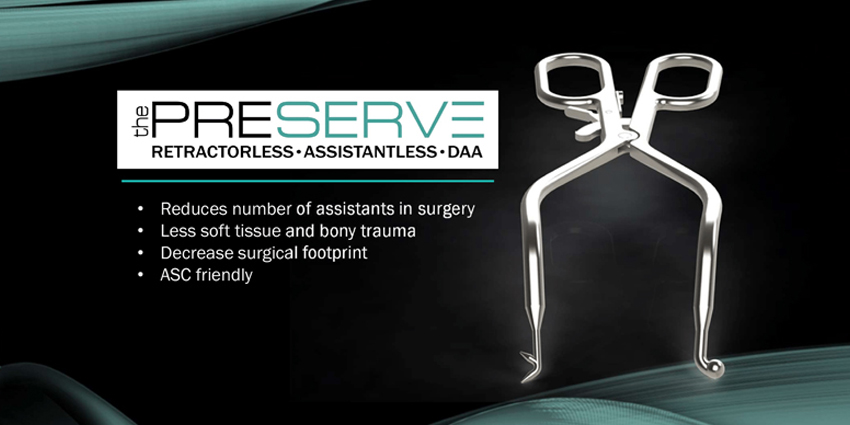
One of his companies, NextStep Arthropedix, has introduced a retractorless, assistantless set of instruments for anterior hip replacement cases. Its purpose is to eliminate soft tissue and bone injury which can be caused by currently available retractors.
The new instrument set is designed around a surgical technique pioneered by Timothy Henderson, M.D., an orthopedic surgeon in practice at One Oak Medical in Paramus, New Jersey. His technique, named “The Preserve,” allows for direct anterior arthroplasty (DAA) without using handheld retractors inside the wound.
According to Dr. Henderson, “The direct anterior retractorless technique which we’ve named The Preserve is a technique that allows us to perform direct anterior replacements without handheld retractors within the wound. My patients routinely can perform straight leg raises in the recovery room and walk out of the operating room without difficulty.”
The Preserve technique along with NextStep Arthropedix’s instruments allows for a more efficient DAA procedure—specifically, one less person in the operating room—potentially decreasing the risk of infection. The Preserve is compatible with most all commercially available direct anterior tables—including, of course, NextStep’s Athello table.
NextStep’s instrument set for The Preserve procedure is brand named “Helpi.” It was created by Theken and his engineering team especially for the femur-first Preserve Technique.
According to NextStep Arthropedix, the Helpi features a rounded end which custom fits into the NextStep female broach, eliminating bone injuries. It has a blunt tip that reduces soft tissue injuries and is easily maneuverable for maximum exposure.
“In the beginning,” said Randy Theken, founder of NextStep Arthropedix, “when first introduced to this procedure by Dr. Timothy Henderson, we did not fully understand and appreciate the value that this procedure provided (using no retractors/one less assistant in the OR).”
“But after some time, the ‘light bulb’ turned on and we realized the huge value this would bring the physician, patient, ambulatory surgery center, and/or hospital. The ‘Helpis’ were developed by one of our new graduate engineers, Ryan Herring. With the help of Dr. Henderson, they both executed on a flawless design the first time.”
“Surgical reproducibility is enhanced by removing variables such as multiple retractors and an additional assistant in the wound trying to hold and manipulate the retractors. Further, The Preserve technique is a systematic step-by-step process, reducing further variability.”
Looking out over the next 12 months, Theken told OTW, “We plan to focus on one thing, training and education. This one concept of ‘training and education’ is the key to the success of The Preserve system. In addition, we are in the process of adapting The Preserve to other areas of hip surgery such as posterior approach.”
For more detailed information about this innovative and interesting procedure and set of instruments, here is a link to NextStep Arthropedix.
Author
React:
Discussion
This is a fascinating development. In my practice we've seen similar outcomes with the revised protocol. The key differentiator seems to be patient selection criteria. Has anyone else noticed the correlation with BMI thresholds?
Great point. I'd push back slightly on the conclusion, the sample size in the cited study is too small to draw population-level inferences. That said, the directional signal is compelling and worth a larger RCT.
We implemented a similar approach last year. Early results are promising but we're still gathering 12-month follow-up data. Happy to share our protocol if anyone is interested.
Join the conversation
Orthopedic professionals are discussing this. Sign in and upgrade to read every comment and add your voice.