
Campbell Clinic orthopedic surgeons Quin Throckmorton, M.D. and Tyler Brolin, M.D. have been awarded the Charles S. Neer Award.
Dr. Quin Throckmorton and Dr. Tyler Brolin Win Neer Award
1 min read Premium comments
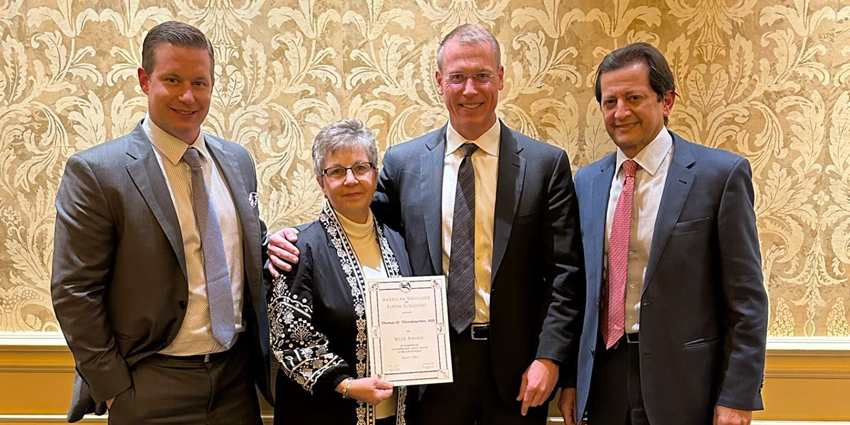
#tylerbrolin#neeraward#quinthrockmorton
The Neer Award is an annual award presented by the American Shoulder and Elbow Surgeons (ASES) Foundation. This is the second time the surgeons have received this prestigious award. The first time was in 2016.
The Neer Award honors Charles S. Neer, M.D., a founding member of ASES and its first president. The award, per the ASES Foundation website, was created to “provide recognition for outstanding clinical and basic science investigations contributing to the understanding, care or prevention of injuries to the shoulder.” Each year, the ASES Foundation awards a Clinical Research Award and a Basic Science Research Award in Shoulder.
This year, the team won the Basic Science Research Award in Shoulder for its study entitled “Muscle Activation Patterns during Active External Rotation after Reverse Total Shoulder Arthroplasty: An Electrophysiological Study of the Teres Minor and Associated Musculature.” A number of other members of the Campbell Clinic team contributed to the study.
Dr. Throckmorton commented, “We are deeply honored to receive this award from the American Shoulder and Elbow Surgeons Foundation which represents a true team effort by the Campbell Clinic research program.”
Dr. Throckmorton continued, “Our clinical research team worked closely with our biomechanics lab to design and execute this study. We are very fortunate to collaborate with such an outstanding group of researchers.”
Dr. Brolin echoed Dr. Throckmorton’s sentiments stating, “This award signifies way more than the work of any one person.”
Dr. Brolin continued, “This prestigious honor belongs to everyone on our Campbell Clinic team who helped us achieve this milestone. We are grateful to the ASES Foundation for recognizing our work and we are humbled to have our research highlighted via the prestigious Neer Award.”
Author
React:
Discussion
This is a fascinating development. In my practice we've seen similar outcomes with the revised protocol. The key differentiator seems to be patient selection criteria. Has anyone else noticed the correlation with BMI thresholds?
Great point. I'd push back slightly on the conclusion, the sample size in the cited study is too small to draw population-level inferences. That said, the directional signal is compelling and worth a larger RCT.
We implemented a similar approach last year. Early results are promising but we're still gathering 12-month follow-up data. Happy to share our protocol if anyone is interested.
Join the conversation
Orthopedic professionals are discussing this. Sign in and upgrade to read every comment and add your voice.