
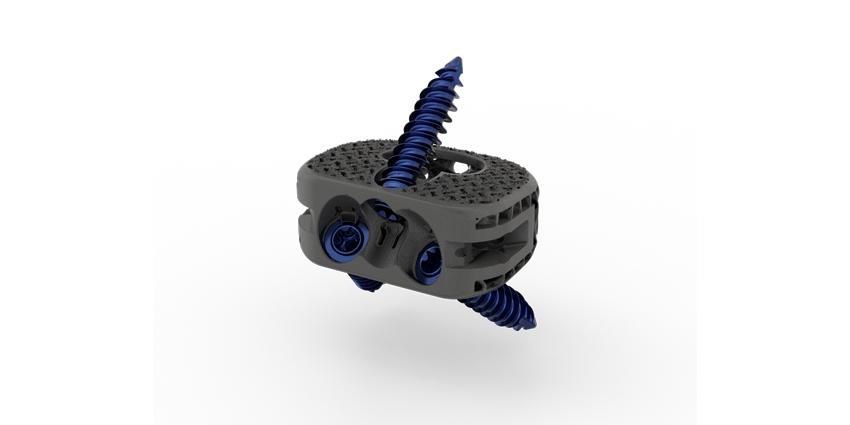
Lewisville, Texas based Orthofix Medical, Inc. has launched a novel Anterior Lumbar Interbody Fusion (ALIF) device, brand named “WaveForm A” that incorporates a number of features which, the company explains, will bring more fixation options and fewer trays to the OR.
New Wave-Like ALIF Spinal Implant Launched
1 min read Premium comments
#orthofixSecondary#seaspine#waveforma
According to the company, “The WaveForm technology is the next level of 3D printed innovation featuring a repeating and continuous wave-like structure designed to prioritize strength, surface porosity and stability to maximize the potential for early stabilization.”
Furthermore, WaveForm was designed to seamlessly integrate with Orthofix’s Meridian ALIF (anterior lumbar interbody fusion) system for treating degenerative disc disease patients.
“Our Meridian ALIF system integrates the most advanced technologies into our surgical sets, minimizing the need for multiple instrument sets during the procedure,” said Kevin Kenny, president of Global Spine. “The WaveForm A interbody is an exciting addition to our portfolio of solutions for ALIF procedures and enables us to provide a more streamlined option so surgeons can do more for their patients.”
“The Meridian with WaveForm A is available in four different fixation options. It includes 2-hole and 3-hole no-profile standalone options as well as a 2-hole and 4-hole TruProfile anterior plate and interbody standalone options.”
“Implant design and surface technology play a vital role in the bone growth process during fusion,” said Dr. Neil Arif Tayyab, orthopedic spine surgeon at Girard Orthopaedic Surgeons, in San Diego, California. “Newer designs such as the WaveForm A interbody can help stimulate a better bone growth response and give me greater confidence that the patient will have a successful fusion.”
Regarding the development process, Kevin Kenny added, “We set out to streamline the ALIF procedure by creating a modular instrument and implant system that could provide diverse fixations options in a reduced number of sets. The design engineers embraced this challenge, and we are pleased with the results. They were able to leverage our Meridian technology and reduce the overall number of trays needed for single and multilevel ALIF procedures.”
Author
React:
Discussion
This is a fascinating development. In my practice we've seen similar outcomes with the revised protocol. The key differentiator seems to be patient selection criteria. Has anyone else noticed the correlation with BMI thresholds?
Great point. I'd push back slightly on the conclusion, the sample size in the cited study is too small to draw population-level inferences. That said, the directional signal is compelling and worth a larger RCT.
We implemented a similar approach last year. Early results are promising but we're still gathering 12-month follow-up data. Happy to share our protocol if anyone is interested.
Join the conversation
Orthopedic professionals are discussing this. Sign in and upgrade to read every comment and add your voice.