
Using variables routinely collected by all healthcare systems, the Hospital for Special Surgery (HSS) and University of Kentucky research team have tested a new algorithm’s ability to predict which patients are most at risk for clinically relevant anemia after surgery. According to study co-author, Michael Ast, M.D., the algorithm was able to predict with 97% accuracy.
New Algorithm 97% Predictive for Post-Op Anemia Risk
2 min read Premium comments
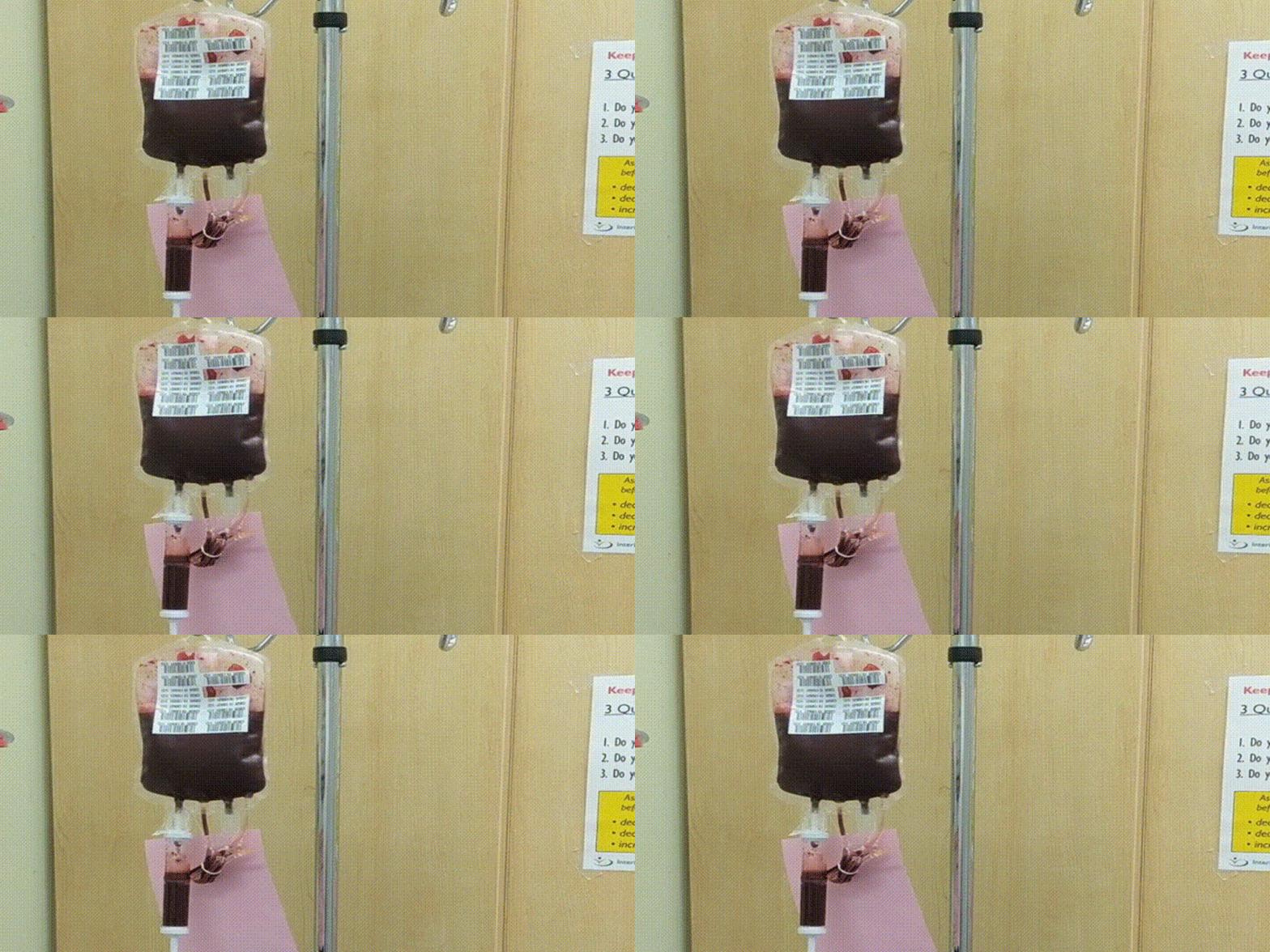
#jointreplacementSecondary#anemia#bloodtransfusion
In addition to the obvious advancement in patient care, a not insignificant achievement, this news also has important ramifications in terms of cost savings (we’re talking millions of dollars) and the overall trend to performing large joint arthroplasties in the ambulatory surgery center setting.
Researchers from Hospital for Special Surgery in New York and the University of Kentucky in Lexington have just published this important new study, “Predicting Postoperative Anemia and Blood Transfusion Following Total Knee Arthroplasty” in the July 2023 edition of The Journal of Arthroplasty.
“Historically,” says Dr. Ast, “one of the concerns following joint replacement surgery has been anemia requiring blood transfusions, which was a significant concern prior to modern blood management protocols, when transfusion rates were as high as 25% in some series.”
Dr. Ast, an Adult Reconstruction and Joint Replacement surgeon at HSS, told OTW, “With contemporary transfusion rates of less than 1% and the transition to outpatient joint replacement, we began to question whether routine blood monitoring was adding value to patient care. Our previous work, as well as that of others, has shown that while routine monitoring of all patients does not add clinically significant value, it is still important to identify patients at risk of post-operative anemia, particularly when assessing candidates for outpatient surgery. In this study, we looked to build an algorithm that would allow us to identify patients at risk for clinically relevant post operative anemia to determine in whom post operative monitoring would be beneficial.”
The researchers looked at data from 14,188 consecutive total knee arthroplasty patients, establishing two multivariable logistic regression models: one to predict postoperative anemia (hemoglobin < 10 g/dL) and one to predict post-operative blood transfusion. The variables included were age, sex, body mass index, preoperative hemoglobin level, tranexamic acid total dose, American Society of Anesthesiologists level, operative time, and drain use.
Dr. Ast commented on the process of developing this model, telling OTW, “The biggest challenge for this model, as is for many models, was identifying a sufficient number of patients to create a generalizable model. After that, the next step required appropriate identification of risk factors to consider when building the algorithm.”
“Using variables routinely collected by all healthcare systems and electronic medical records, we were able to predict with 97% accuracy whether or not a patient would have clinically relevant anemic after surgery—meaning that anemia obviously [is] going to happen to some extent after any surgery, but it is truly clinically relevant when the patient requires a transfusion. Broad application of this algorithm could dramatically improve the utility of our postoperative laboratory monitoring while potentially saving a significant amount of money for our healthcare system.”
When OTW asked how use of this model might spread, Dr. Ast noted, “As we validate this algorithm across diverse patient populations and geographic locations, we hope to create a tool that other surgeons can use when determining post-operative lab testing after joint replacement and when evaluating candidates for outpatient surgery.”
Author
React:
Discussion
This is a fascinating development. In my practice we've seen similar outcomes with the revised protocol. The key differentiator seems to be patient selection criteria. Has anyone else noticed the correlation with BMI thresholds?
Great point. I'd push back slightly on the conclusion, the sample size in the cited study is too small to draw population-level inferences. That said, the directional signal is compelling and worth a larger RCT.
We implemented a similar approach last year. Early results are promising but we're still gathering 12-month follow-up data. Happy to share our protocol if anyone is interested.
Join the conversation
Orthopedic professionals are discussing this. Sign in and upgrade to read every comment and add your voice.