
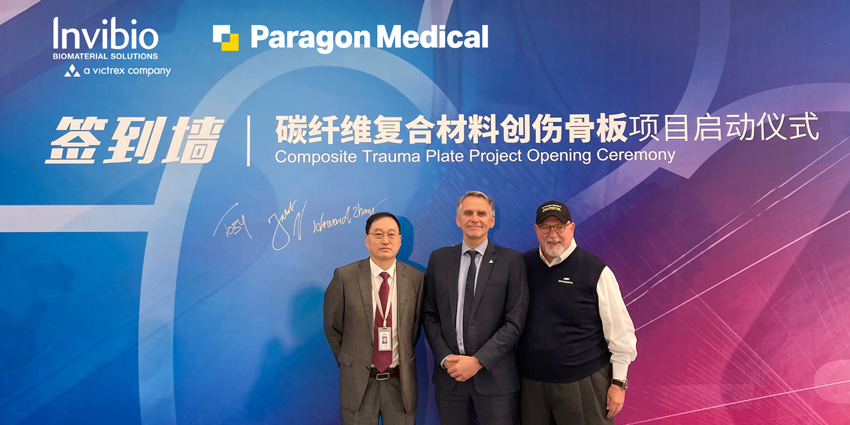
Invibio Biomaterial Solutions, which is part of Victrex plc, has announced a collaboration with medical device manufacturer Paragon Medical to scale up production of its PEEK-OPTIMA™ Ultra-Reinforced medical trauma devices.
Invibio and Paragon Medical Team Up to Produce PEEK Trauma Devices
1 min read Premium comments
Secondary#invibio#paragonmedical#peekoptima
The collaboration also coincides with Paragon Medical’s recent expansion of its manufacturing facility in Changzhou, China.
Victrex CEO Jakob Sigurdsson said, “Trauma is one of Victrex’s key mega-programs, where we see significant growth opportunities over the years ahead and the opportunity to enhance patient outcomes. Clinical data on PEEK based trauma plates is already encouraging and initial demand is exceeding our expectations.”
“We have invested over several years now, and bring a wealth of intellectual property in this area. Paragon Medical will help us support manufacturing scale up, and they bring an excellent reputation as one of the world’s premier medical contract manufacturers. We are delighted to work with them to grow the composite trauma space and to make it easier for medical device companies to adopt this technology.”
Sigurdsson continued, “With a broad operating footprint in Europe, China and America, Paragon Medical is an attractive company to work with, dealing with evolving supply chain strategies within the medical device industry.”
This collaboration is one of many steps Invibio has already taken to meet customer demand. Earlier this year, Invibio opened a new medical device product development and manufacturing center in Leeds, UK. Both the Leeds product development center and the collaboration with Paragon Medical offer medical device customers an increase in manufacturing capabilities.
Polyetheretherketone (PEEK) is a polyaromatic semi-crystalline thermoplastic polymer. PEEK-based implantable medical devices have been utilized for more than 20 years. According to Invibio, the “benefits of PEEK OPTIMA Ultra reinforced trauma plates such as increased fatigue lifetime, tailored stiffness and improved imaging are now being utilized to treat a more challenging patient population.”
Author
React:
Discussion
This is a fascinating development. In my practice we've seen similar outcomes with the revised protocol. The key differentiator seems to be patient selection criteria. Has anyone else noticed the correlation with BMI thresholds?
Great point. I'd push back slightly on the conclusion, the sample size in the cited study is too small to draw population-level inferences. That said, the directional signal is compelling and worth a larger RCT.
We implemented a similar approach last year. Early results are promising but we're still gathering 12-month follow-up data. Happy to share our protocol if anyone is interested.
Join the conversation
Orthopedic professionals are discussing this. Sign in and upgrade to read every comment and add your voice.