
The U.S. Food and Drug Administration (FDA) has granted 510(k) clearance to three surgical mesh products, expanding the indications for use.
FDA Expands Indications for Novel Soft Tissue Repair
2 min read Premium comments
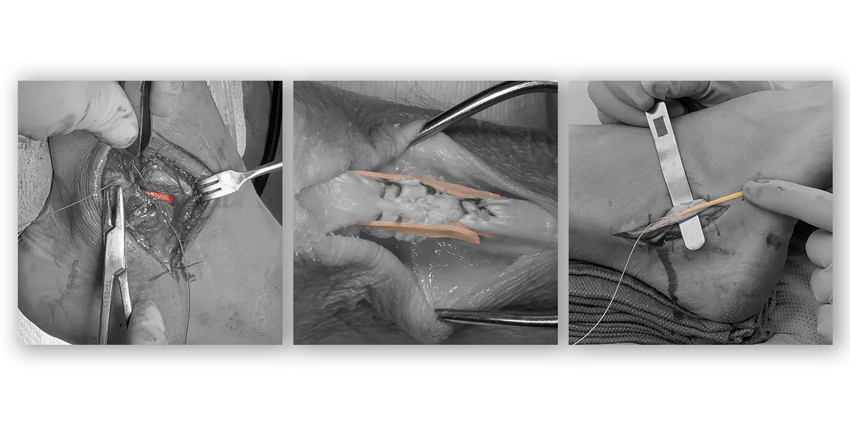
Secondary#artelon#flexband#flexpatch
According to the FDA’s 510(k) summary document, the products are knitted mesh made from fibers “made of degradable polycaprolactone-based polyurethane urea.” The construction of the fibers “permits the mesh to be cut into any desired shape or size without unraveling.” Additionally, the devices “have suture attached to each end of the knitted mesh strip. The pre-loaded suture is intended to aid in usability in the operating room. The devices are supplied sterile, one product per package in double layer peel pouch packaging.”
Intended use is for reinforcement of soft tissue where weakness exists.
Furthermore, according to the FDA clearance document, the soft tissue repair products (manufacturer is Artelon, Inc.) “are also intended for reinforcement of soft tissues that are repaired by suture or other fixation devices during tendon and ligament repair surgery including:
- reinforcement of rotator cuff, patellar,
- Achilles,
- biceps,
- quadriceps tendons,
- medial collateral ligament,
- lateral collateral ligament,
- spring ligament,
- deltoid ligament,
- ulnar collateral ligament or
- other tendons or extra-articular ligaments.”
The FDA’s documents also noted where the devices are NOT intended for use—specifically, “to replace normal body structure or provide the full mechanical strength to support the rotator cuff, patellar, Achilles, biceps, quadriceps tendons, medial collateral ligament, lateral collateral ligament, spring ligament, deltoid ligament, ulnar collateral ligament or other tendons or extra-articular ligaments.”
Sutures, in other words, provide the mechanical strength for the tendon repair while Artelon’s products reinforce soft tissue and provide a degradable scaffold that is incorporated into the patient’s own tissue. In short, Georgia based Artelon, Inc., the company that submitted the devices for 510(k) clearance, improves outcomes.
The devices affected by the clearance announcement are the FlexBand®, FlexPatch®, and FlexBand® Plus.
All three products use Artelon’s Dynamic Matrix® technology which is, according to the company, a “proprietary polymeric bio-textile for musculoskeletal soft tissue reinforcement.”
For OTW’s recent coverage of Artelon and its Dynamic Matrix technology, see “Joint Kinematics and Stability Firm, Artelon, Raises $20 Million.”
Artelon CEO Aaron Smith commented, “This new regulatory clearance establishes a unique and specific framework of U.S. marketing claims for reinforcement of ligaments.”
Smith continued, “Recent innovation in our space has been mostly focused on fixation of ligaments to bone, but little has been done to address failure of the ligament tissues themselves, which are often diseased and may lead to poor surgical outcomes. We are currently a leader in the large and growing U.S. ankle instability market. This new set of claims permits us to take on a multitude of unmet clinical challenges in the ankle and other joints and dramatically expand our addressable market.”
Author
React:
Discussion
This is a fascinating development. In my practice we've seen similar outcomes with the revised protocol. The key differentiator seems to be patient selection criteria. Has anyone else noticed the correlation with BMI thresholds?
Great point. I'd push back slightly on the conclusion, the sample size in the cited study is too small to draw population-level inferences. That said, the directional signal is compelling and worth a larger RCT.
We implemented a similar approach last year. Early results are promising but we're still gathering 12-month follow-up data. Happy to share our protocol if anyone is interested.
Join the conversation
Orthopedic professionals are discussing this. Sign in and upgrade to read every comment and add your voice.