
A self-service, particle-based SaaS simulation platform has been launched for use in the orthopedic and spinal implant industry.
Ultra-Realistic Implant Simulation Testing Launches
2 min read Premium comments
Secondary#alfonsocloud#lifespans#medicaldevicetesting
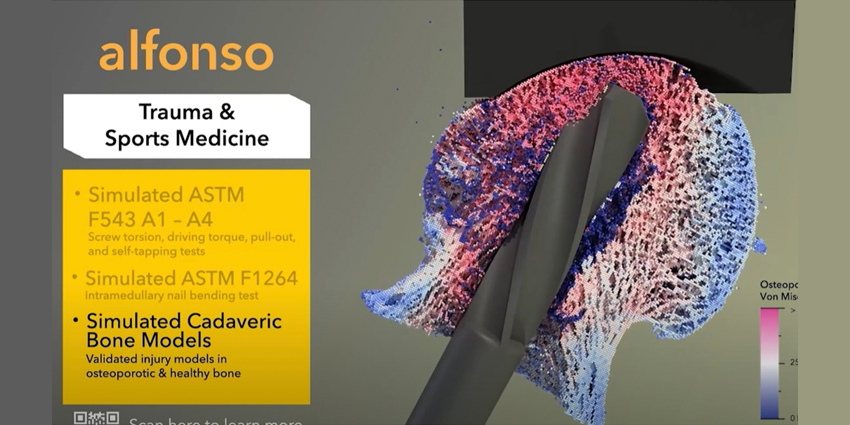
The online platform gives implant manufacturers the ability to design, conduct and perform ultra-realistic tests for orthopedic and spine devices including joint reconstruction, trauma, and spinal implants. The portal is called the Alfonso™ Cloud and it was created by the team at Lifespans, Ltd., a software company.
According to the company, Alfonso is the “world’s first simulation system capable of simulating the cracking and crushing of realistic trabecular bone structures.” It incorporates a “‘particle-based’ computer model of bone tissue and bonelike materials” and “can provide extremely accurate models of material damage, such as during the loading of porous 3D-printed devices or implant subsidence in bone and foam.”
To see a short video of Alfonso in action, here is a video from OTW Broadcasting: https://www.youtube.com/watch?v=9QiYi5IyfyE
Research and development teams can use the online portal to complete tests with “downloadable results available in 1-2 days.” According to Lifespans, companies can select from “a growing library of standard ASTM tests” and the testing models are “provided with validation data based on V&V 40 standards.”
OTW spoke with Sloan Kulper, Ph.D., the CEO and co-founder of Lifespans, about Alfonso. OTW asked Dr. Kulper about what tests are currently available. Dr. Kulper told OTW, “Right now we have validated models of ASTM F543 A3 (screw pull out from a variety of foam grades), F2077 (spinal spacer axial compression), and F2267 (spinal spacer subsidence in foam).”
Dr. Kulper also informed OTW that ASTM F1264 (IM nail bending) ) is being launched in May 2023. Dr. Kulper elaborated, “This will be followed by press fit, cadaveric bone, and dynamic testing in the coming months.”
OTW also had the chance to discuss custom tests with Dr. Kulper. Dr. Kulper explained, “In principle, we can turn around a model with a minor change from the standard within a few days. Complex models usually take at least a few weeks.”
Dr. Kulper continued, “For longer projects, we usually save our customers significant time overall, however, as there are fewer false starts resulting from physically prototyping and testing implant designs that don’t end up working. We have been creating custom models for the last 18 months and until now it has represented the majority of our business.”
Finally, Lifespans was part of Orthopedics This Week’s PITCH program. Here is a link to that video: https://www.youtube.com/watch?v=9QiYi5IyfyE
Author
React:
Discussion
This is a fascinating development. In my practice we've seen similar outcomes with the revised protocol. The key differentiator seems to be patient selection criteria. Has anyone else noticed the correlation with BMI thresholds?
Great point. I'd push back slightly on the conclusion, the sample size in the cited study is too small to draw population-level inferences. That said, the directional signal is compelling and worth a larger RCT.
We implemented a similar approach last year. Early results are promising but we're still gathering 12-month follow-up data. Happy to share our protocol if anyone is interested.
Join the conversation
Orthopedic professionals are discussing this. Sign in and upgrade to read every comment and add your voice.