
Which surgical approach, exactly, will deliver a safer, more consistent total hip arthroplasty outcome? Is it the anterior approach? The answer from a 2,888-patient study may well surprise you.
2,888 THA Patient Complication Study: Anterior or Posterior?!
2 min read Premium comments
#totalhiparthroplastySecondary#dislocationrates#posteriorapproach
Citing the snarl of statistics regarding this very subject in the literature, a team from New York’s Hospital for Special Surgery (HSS) designed a study to, they hoped, settle the issue of the optimal (if not also appropriate) total hip arthroplasty (THA) surgical approach.
Their work, “Complication Rate after Primary Total Hip Arthroplasty Using the Posterior Approach and Enabling Technology: A Consecutive Series of 2,888 Hips,” appears in the April 21, 2023, edition of The Journal of Arthroplasty.
In order to compare dislocation rates of the posterior versus the direct anterior approach, the investigators reviewed 2,888 consecutive, primary THAs performed via the posterior approach between 1/1/18 and 9/30/21. The procedures were performed by one of four orthopedic surgeons.
The team collected data on all patients who experienced a dislocation following a primary THA as well as information on patients who had complications for various reasons (infection, fracture, dislocation, other).
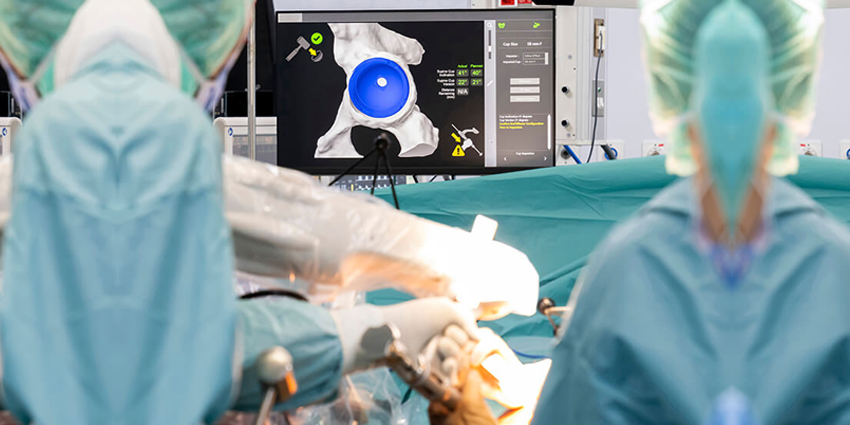
Jonathan M. Vigdorchik, M.D., a hip and knee surgeon at HSS, described the study methodology to OTW, “We did not use any fancy software, only a standardized series of X-rays for hip-spine analysis: AP [anteroposterior] pelvis, a standing lateral and a sitting lateral X-ray including the hip and spine. We used computer navigation and robotics to perform the surgery and execute the preoperative plans.”
In three years of follow-up, 39 patients (39 hips) had some form of musculoskeletal issue (dislocation, infection, periprosthetic fracture, or other) related to the involved joint.
“The total complication rate was 1.1%., the dislocation rate was 0.35% and the risk of infection was 0.24%,” stated Dr. Vigdorchik to OTW. “These rates are the lowest in the literature for hip replacement surgery, regardless of surgical approach.”
“We were thankful that the complication rates were so low because all intensity goes into performing a procedure with the lowest risk of anything bad happening. The national average for infection is ~1%; the national average for dislocation is ~1.5%. When looking at the registry data, the most common complications of a total hip replacement are infection, dislocation, and fracture, in that order.”
“In our series, we found that our most common complication was periprosthetic fracture, then dislocation, and infection. Interestingly, when you stratify patients by their hip-spine classification, the dislocation rate in a normal spine is less than 1 in 1,000 with the posterior approach. We have now also taken steps to reduce our incidence of periprosthetic fracture by changing stem designs to a collared stem, which further decreased our complications rates (in a study that is being submitted).”
“These results conclusively support the use of posterior approach as having equal if not lower complication rates than any other surgical approach in the literature. The debate regarding surgical approaches needs to stop, and the focus should turn to good preoperative planning and correct surgical execution, regardless of surgical approach. Today, in 2023, it does not matter which surgical approach you choose, as long as you do it well! Many of these complications are preventable with thoughtful planning and precise surgical execution.”
Author
React:
Discussion
This is a fascinating development. In my practice we've seen similar outcomes with the revised protocol. The key differentiator seems to be patient selection criteria. Has anyone else noticed the correlation with BMI thresholds?
Great point. I'd push back slightly on the conclusion, the sample size in the cited study is too small to draw population-level inferences. That said, the directional signal is compelling and worth a larger RCT.
We implemented a similar approach last year. Early results are promising but we're still gathering 12-month follow-up data. Happy to share our protocol if anyone is interested.
Join the conversation
Orthopedic professionals are discussing this. Sign in and upgrade to read every comment and add your voice.