
The U.S. Food and Drug Administration (FDA) has granted 510(k) clearance to an implantable screw sleeve bone fixation device for use in spine surgery.
Truly Novel Pedicle Screw Fixation Device Cleared by FDA
2 min read Premium comments
#ogmendimplantenhancementsystem#wovenorthopedictechnologies
According to the FDA’s 510(k) summary document, the system is intended to “augment pedicle screw fixation when a screw has lost purchase due to screw loosening, back-out, or breakage.” It is for use with “rigid, thoracolumbar pedicle screw systems where a screw is inserted posteriorly, through the pedicle, and into the vertebral body.” The system is “for use in skeletally mature patients.”
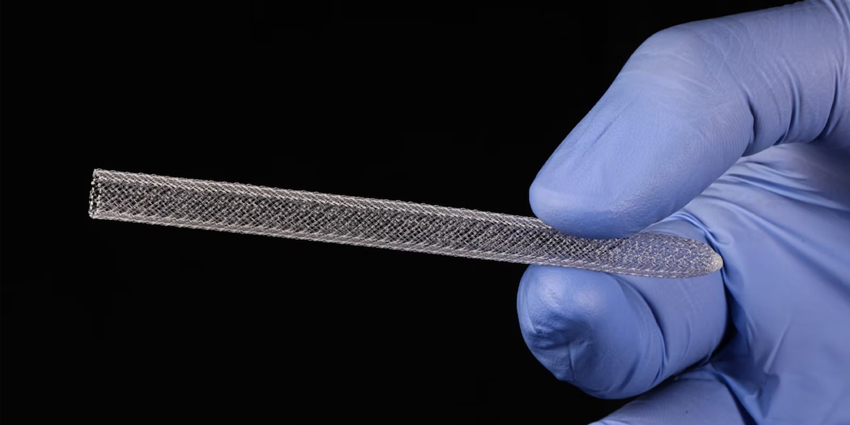
The system includes a permanently implanted sleeve and an inserter. When the implant is inserted into a prepared bone hole, it is “designed to use the principles of interference fit, surface area contact, and pressure distribution to secure a screw to bone and achieve stability at the screw-to-bone interface to allow for subsequent healing.”
In order to qualify for the shorter and earlier 510(k) clearance the device must be substantially equivalent to a predicate device. Again, from the FDA document, the implant is “identical to the primary predicate in material, design, principle of operation, implant size, sterilization method, inserter material, and shelf life.” Additionally, the system is “substantially equivalent to the primary predicate device with respect to intended use, technological characteristics, design, materials, principles of operation, and procedural steps.” The primary predicate device is an implant system made by the same company that submitted the current device for 510(k) clearance.
Manchester, Connecticut-based Woven Orthopedic Technologies, LLC, a medical device company focused on improving neuromusculoskeletal treatments, submitted the device for 510(k) clearance. The device is called the Ogmend® Implant Enhancement System.
According to the company, “surgeons routinely face scenarios that make it difficult to achieve secure fixation between screws and bone.” The system resolves this issue and, per the press release, “can be deployed in less than 2 minutes and is used with a wide range of screw systems from a variety of suppliers.”
In the press release, Woven Orthopedic Co-founder and President Brandon Bendes said, “We are thrilled to deliver surgeons a simple, reliable solution to help overcome one of the most prevalent yet least discussed challenges in orthopedic and spine surgery: the ability to more confidently use surgical screws when operating in compromised fixation scenarios.”
The company is planning to make Ogmend available in the United States through a staged, regional release. A release that some providers eagerly await. Hospital for Special Surgery Chief Emeritus of Spine Frank Cammisa Jr., M.D. stated, “This is game changing.”
Dr. Cammisa continued, “A large, growing percentage of my patients have conditions that make it difficult to achieve strong fixation. Ogmend® gives me a very simple way to manage these patients and generate the fixation needed to ensure great outcomes. My colleagues and I are looking forward to having this available in the U.S.”
Author
React:
Discussion
This is a fascinating development. In my practice we've seen similar outcomes with the revised protocol. The key differentiator seems to be patient selection criteria. Has anyone else noticed the correlation with BMI thresholds?
Great point. I'd push back slightly on the conclusion, the sample size in the cited study is too small to draw population-level inferences. That said, the directional signal is compelling and worth a larger RCT.
We implemented a similar approach last year. Early results are promising but we're still gathering 12-month follow-up data. Happy to share our protocol if anyone is interested.
Join the conversation
Orthopedic professionals are discussing this. Sign in and upgrade to read every comment and add your voice.