
Patients with “sandwich fusion” and atlantoaxial dislocation often present with unique clinical features that require a variety of surgical techniques to manage their condition, a new study finds.
Care for a ‘Sandwich’ With That Fusion?
2 min read Premium comments
Secondary#atlantoaxialdislocationsurgery#sandwichfusion
The study, “Clinical and Surgical Characteristics of Patients with Atlantoaxial Dislocation in the Setting of “Sandwich Fusion”: A Case-Control Study,” was published in the Journal of Bone and Joint Surgery on February 24, 2023.
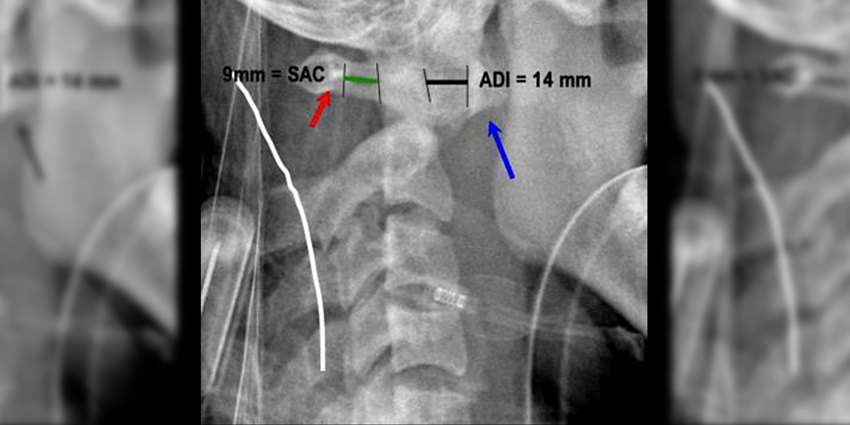
“Patients with ‘sandwich fusion’ (concomitant C1 occipitalization and C2-C3 nonsegmentation), a subtype of Klipper-Feil syndrome, are at particular risk for developing atlantoaxial dislocation. However, the clinical and surgical characteristics of atlantoaxial dislocation in patients with sandwich fusion have not been clearly defined,” the researchers wrote.
For their retrospective case-control study, they used data from 253 patients with sandwich atlantoaxial dislocation who underwent a surgical procedure between 2000 and 2018. The researchers then matched the group’s data to that of a group of patients with non-sandwich atlantoaxial dislocation.
They used the Japanese Orthopaedic Association scale to measure neurological function.
Overall, patients with sandwich atlantoaxial dislocation had symptom onset at a younger age (34.8 compared with 42.8 years; p < 0.001) and a higher likelihood for myelopathy (87.4% compared with 74.7%; p < 0.001).
The patients with sandwich fusion also experienced lower cranial nerve palsy more often than the control group (7.9% compared with 0.0%; p <0.001). They also had a lower preoperative Japanese Orthopaedic Association score (13.4 compared with 14.2; p < 0.001), and a higher incidence of accompanying Type-I Chiari malformation (20.9% compared with 1.2%; p < 0.001) and syringomyelia (21.3% compared with 1.6%; p < 0.001).
Patients with sandwich atlantoaxial dislocation also had a higher incidence of undergoing transoral release (28.5% compared with 5.1%, p < 0.001), a higher use of salvage fixation techniques (34.4% compared with 6.3%; p < 0.001), lower postoperative results for the Japanese Orthopaedic Association score (14.9 compared with 15.9; p < 0.001) and improvement rate (43.8% compared with 58.2%; p < 0.001).
The surgeons performing the procedures on the patients with sandwich atlantoaxial dislocation were required to perform a wider range of internal fixation techniques and transoral release procedures, the study authors said.
Study authors include Nanfang Xu, M.D., Yinglun Tian, M.D., Ming Yan, M.D., Weishi Li, M.D., and Shenglin Wang, M.D., all of the Peking University Third Hospital, Beijing, People’s Republic of China, Engineering Research Center of Bone and Joint Precision Medicine, Ministry of Education, Beijing and Beijing Key Laboratory of Spinal Disease Research. Lihao Yue and Kan-Jin Hung, M.D., both of Peking University Health Science Center, and Xiangyu Hou, M.D., of Peking University Third Hospital in Beijing were also involved in the study.
Author
React:
Discussion
This is a fascinating development. In my practice we've seen similar outcomes with the revised protocol. The key differentiator seems to be patient selection criteria. Has anyone else noticed the correlation with BMI thresholds?
Great point. I'd push back slightly on the conclusion, the sample size in the cited study is too small to draw population-level inferences. That said, the directional signal is compelling and worth a larger RCT.
We implemented a similar approach last year. Early results are promising but we're still gathering 12-month follow-up data. Happy to share our protocol if anyone is interested.
Join the conversation
Orthopedic professionals are discussing this. Sign in and upgrade to read every comment and add your voice.