
The U.S. Food and Drug Administration (FDA) has granted 510(k) clearance to a web-based medical image management and processing system.
510(k) Clearance for Web-Based Orthopedic Planning Solution
2 min read Premium comments
Secondary#peekmed
According to the 510(k) summary document, the system is designed to “help healthcare professionals carry out pre-operative planning for several surgical procedures, based on their imported patients’ imaging studies.” The indications for use section of the summary document further explained that “experience in usage and a clinical assessment is necessary for the proper use of the system in the revision and approval of the output of the planning.” Additionally, “the multi-platform system works with a database of digital representations related to surgical materials supplied by their manufacturers.”
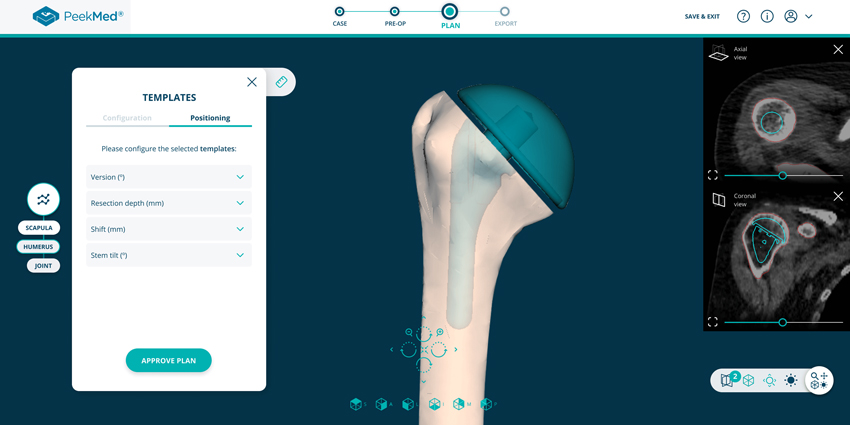
The system is “capable of representing the medical images in a 2D or 3D environment, performing relevant measurements on those images and also capable of adding templates, it then can perform a total overview of the surgery.” The system is software. This means that it “does not interact with any part of the body of the user and/or patient.”
A device must be substantially equivalent to a predicate device to qualify for 510(k) clearance. The device and its predicate are both medical software by the same company. Both enable healthcare professionals to perform orthopedic pre-surgical planning.
There are a number of differences between the predicate device and the latest system, most notably is that this system is web-based. According to the 510(k) summary document, the predicate device supports importing medical images from PACS [picture archiving and communication systems] while the web-based device does not. Additionally, the predicate device supports the use of MRI medical images while the web-based device does not.
Many of the differences actually expand the available options for the user. They do not, according to the 510(k) summary document, raise any “safety or effectiveness questions when compared to the predicate.”
The system is called PeekMed® web. It was submitted for 510(k) clearance by Peek Health, S.A. of Braga, Portugal.
According to the company’s press release, the system is “powered by artificial intelligence and deep learning technologies.” Because it is web based, it is now “faster and simpler” for orthopedic surgeons to use. The new system “supports live automatic segmentation of CT scans and X-Rays, automatic landmarks detection, and automatic planning.” The technology can provide an accurate plan to the surgeon in under 30 seconds.
Peek Health, S.A. Chairman & CEO João Pedro Ribeiro said, “With this FDA clearance, PeekMed® is ready, once again, to be a game-changer in the integration of technology with orthopedics. Having the ability to get a plan in less than 30 seconds is just incredible and a huge achievement for our team.”
Author
React:
Discussion
This is a fascinating development. In my practice we've seen similar outcomes with the revised protocol. The key differentiator seems to be patient selection criteria. Has anyone else noticed the correlation with BMI thresholds?
Great point. I'd push back slightly on the conclusion, the sample size in the cited study is too small to draw population-level inferences. That said, the directional signal is compelling and worth a larger RCT.
We implemented a similar approach last year. Early results are promising but we're still gathering 12-month follow-up data. Happy to share our protocol if anyone is interested.
Join the conversation
Orthopedic professionals are discussing this. Sign in and upgrade to read every comment and add your voice.