
An ulna intramedullary nail system has been granted 510(k) clearance by the U.S. Food and Drug Administration (FDA).
Ulna Intramedullary Nail System Gets 510(k) Clearance
2 min read Premium comments
#510clearanceSecondary#conventusflowerorthopedics#flexthread#ulnaintramedullarynailsystem
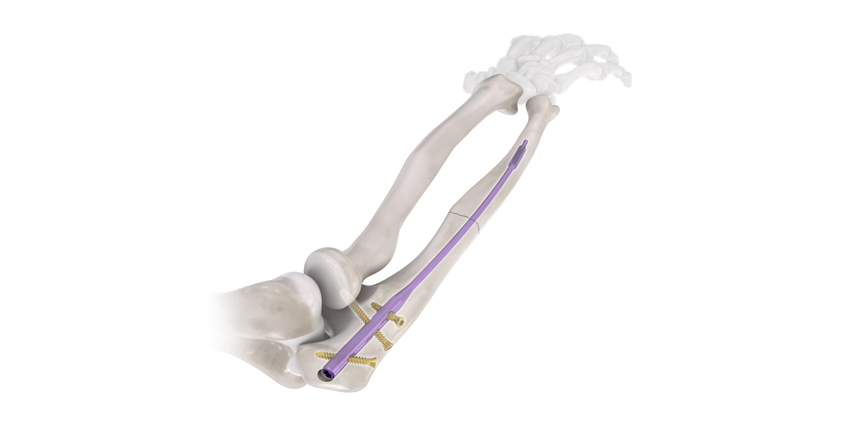
According to the FDA’s 510(k) summary document, the system is intended for “use in the fixation of fractures and osteotomies of the ulna.”
The ulna intramedullary nail system is comprised of an “intramedullary fixation device with a flexible threaded tip to engage the intramedullary canal of the ulnar diaphysis from an antegrade approach and cortical screws to provide stability and articular support in the proximal ulna and olecranon.”
A device must be substantially equivalent to a predicate device to qualify for 510(k) clearance. The predicate device is an intramedullary nail system that is also used for the treatment of fractures and osteotomies.
It is called the Flex-Thread™ Distal Fibula Intramedullary Nail System and is made by Conventus Flower Orthopedics. The 510(k) summary document does note that the predicate device is intended for treatment for the fibula (not the ulna).
The use of the device for treatment for the ulna is supported by a second predicate device, also an intramedullary nail system. The second predicate device is called the Synthes Elastic Intramedullary Nail (EIN) System (Line Extension).
Flower Orthopedics Corporation doing business as Conventus Flower submitted the application for the device which is called the Flex-Thread™ Ulna Intramedullary Nail System. Conventus Flower Orthopedics, a privately held medical technology company, made the announcement.
The clearance broadens the application of Conventus Flower Orthopedics’s Flex-Thread technology, which it first introduced in 2021. According to the press release, the “unique flexible design allows the nail to ‘flex’ as it is inserted into the intramedullary canal, providing ease of insertion and point-contact fixation within the intramedullary canal.”
According to the company, this is the “first and only flexible, threaded ulna IM (intramedullary) nail.” The company will offer it in a variety of diameters and lengths.
Conventus Flower Orthopedics CEO Brad Niemann commented, “We are excited to introduce our second system within our Flex-Thread platform. The Flex-Thread Ulna Intramedullary Nail System demonstrates our continued commitment to introducing innovative and differentiated technology to the market.”
Niemann continued, “With over 650 cases utilizing our Flex-Thread Distal Fibula Nail System, we have seen tremendous results and have been extremely pleased with the adoption of this unique technology. We expect the Flex-Thread Ulna Intramedullary Nail System to be well received and a terrific option for fracture management in the upper extremity market segment.”
Author
React:
Discussion
This is a fascinating development. In my practice we've seen similar outcomes with the revised protocol. The key differentiator seems to be patient selection criteria. Has anyone else noticed the correlation with BMI thresholds?
Great point. I'd push back slightly on the conclusion, the sample size in the cited study is too small to draw population-level inferences. That said, the directional signal is compelling and worth a larger RCT.
We implemented a similar approach last year. Early results are promising but we're still gathering 12-month follow-up data. Happy to share our protocol if anyone is interested.
Join the conversation
Orthopedic professionals are discussing this. Sign in and upgrade to read every comment and add your voice.