
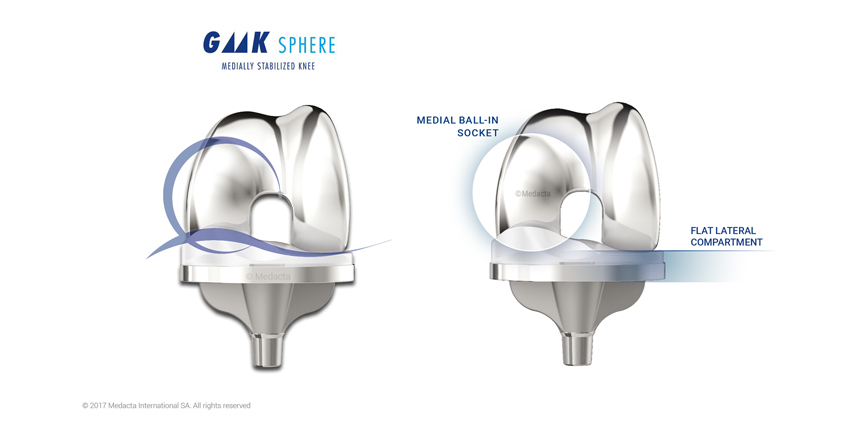
Most knee surgeons assume that a more stable implant will provide better outcomes. But, in what will probably be viewed as a counter-intuitive result, a solid new study found evidence that a particular type of motion preserving implant, the medial-pivot knee, actually gave patients greater anteroposterior stability.
New Knee Study Reaches Counter-Intuitive Outcome
2 min read Premium comments
Secondary#anteroposteriorstability#kinematicalignment#medialpivot
The new work is from Washington State University and the Spokane Joint Replacement Center. The research groups found that total knee arthroplasty (TKA) with a kinematic alignment approach and a medial-pivot implant provides superior anteroposterior stability as well as better outcomes when compared to a posterior-stabilized implant.
The study, “Mid-Flexion, Anteroposterior Stability of Total Knee Replacement Implanted with Kinematic Alignment,” was published in the January 4, 2023, edition of The Journal of Bone and Joint Surgery.
Using an unrestricted kinematic alignment surgical procedure for all patients, the researchers measured stability in 45º mid-flexion and 90º of flexion using a radiographic stress test procedure. A subset of 63 patients were selected from a parent study of 200 subjects. A total of 30 patients had a posterior-stabilized implant, while 33 had a medial-stabilized device.
David Scott, M.D. a co-author on the work, explained the study results to OTW, “We found that the difference in anteroposterior stability between the medial-pivot and posterior-stabilized implants was greatest in mid-flexion, but there was also a statistically significant difference favoring the medial-pivot implant group in the female subset in 90º of flexion (2.3 in medial-stabilized patients versus 5.4 mm in the posterior-stabilized group).”
The mean Knee Society Pain score was 48.8 in the medial-stabilized group, compared with 44.8 in the posterior-stabilized group; the mean Knee Society Pain/Motion score was 98.4 in the medial-stabilized group, compared with 89.5 in the posterior-stabilized group; and the mean Knee Society Function score was 95.5 in the medial-stabilized group, compared with 85.7 in the posterior-stabilized group.
“In addition,” said Dr. Scott to OTW, “we found a significant correlation between higher mid-flexion stability and the ability to return to sports as indicated in question 12 of the Forgotten Joint Score, again in favor of the medial-pivot implant. In the parent study, with 200 randomized patients, mean flexion at two years was greater in the implant group with greater conformity: 132º in the medial-pivot group and 124º in the posterior-stabilized group.”
“Posterior-stabilized knees have traditionally been thought to provide more stability, but the reality is that these knees are both Anterior Cruciate Ligament-deficient and Posterior Cruciate Ligament-deficient in mid-flexion, as well as Anterior Cruciate Ligament-deficient in deeper flexion. Indeed, sagittal stability (anteroposterior) was much better in the medial-pivot group in this study.”
“Arthroplasty surgeons generally assume that a more stable knee device will provide better outcomes, but interestingly there is very little in the literature that illustrates a causal connection between better anteroposterior stability in knee arthroplasty and better outcomes.”
“This study is one of the first to do so, comparing medial-pivot and posterior-stabilized, with a kinematic alignment protocol. The medial-pivot implant group demonstrated greater anteroposterior stability in mid-flexion, as determined by measurements of laxity, and better Knee Society outcome measures, and a higher rate of return to sports activities, versus a posterior-stabilized group.”
Author
React:
Discussion
This is a fascinating development. In my practice we've seen similar outcomes with the revised protocol. The key differentiator seems to be patient selection criteria. Has anyone else noticed the correlation with BMI thresholds?
Great point. I'd push back slightly on the conclusion, the sample size in the cited study is too small to draw population-level inferences. That said, the directional signal is compelling and worth a larger RCT.
We implemented a similar approach last year. Early results are promising but we're still gathering 12-month follow-up data. Happy to share our protocol if anyone is interested.
Join the conversation
Orthopedic professionals are discussing this. Sign in and upgrade to read every comment and add your voice.