
Mattel, Inc., which is based in El Segundo, California, and is the world’s largest manufacturer of toys has, with advice from Luke Macyszyn, M.D., MA, FAANS, FACS, introduced its first-ever doll with scoliosis.
Meet Chelsea – a Children’s Doll With Scoliosis
2 min read Premium comments
#scoliosis#chelsea#mattel#discsports&spinecenter
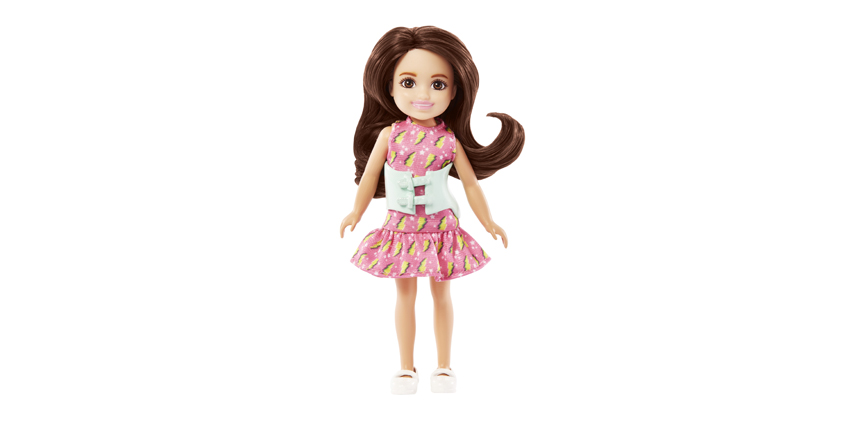
The Chelsea™ doll is part of the company’s product line for Barbie’s little sister. The doll, which stands six inches tall, has scoliosis and comes with a removable brace. It also features long brown hair, a removable pink dress with playful print, and white shoes.
Dr. Macyszyn is a board-certified, fellowship-trained neurosurgeon and served as an advisor to Mattel throughout the design and development of the doll.
OTW spoke with Dr. Macyszyn about collaborating with Mattel. Dr. Macyszyn told OTW, “The collaboration started with Mattel reaching out to me to ask if I could assist them with developing a new ‘Chelsea’ doll that has scoliosis.”
Dr. Macyszyn continued, “I was immediately very intrigued because not only is treating scoliosis a passion of mine, but I also thought this would be a great opportunity to educate children and help them deal with this difficult disorder.”
OTW also asked Dr. Macyszyn about the feedback he provided for the scoliosis doll. Dr. Macyszyn explained, “We began by meeting online, which initially consisted of me just kind of teaching and informing the development team about the diagnosis and treatment of scoliosis in adolescent children.”
Dr. Macyszyn continued, “We then proceeded with 2D drawings and models of a potential doll, which—in the end—was transformed into a full 3D model. I worked with the Mattel team to augment this 3D model further and create a doll that is very clinically realistic, including the brace that she wears. This feedback was then incorporated into the final product, which has now been released.”
The Barbie brand has been focused on creating an inclusive doll portfolio. The Chelsea doll was designed to foster inclusivity and normalize the wearing of a back brace.
Executive Vice President and Global Head of Barbie and Dolls at Mattel Lisa McKnight commented, “We believe in the power of representation and are committed to creating dolls in a variety of looks so that kids can see themselves in Barbie—and now, in a line celebrating Barbie’s little sister Chelsea.”
McKnight continued, “We’re proud to launch the first-ever Chelsea doll with a removable back brace to continue to be more reflective of the world kids see around them. Our Chelsea line provides infinitely more ways to spark storytelling, all while providing kids with a way to develop their empathy and social processing skills through doll play.”
Author
React:
Discussion
This is a fascinating development. In my practice we've seen similar outcomes with the revised protocol. The key differentiator seems to be patient selection criteria. Has anyone else noticed the correlation with BMI thresholds?
Great point. I'd push back slightly on the conclusion, the sample size in the cited study is too small to draw population-level inferences. That said, the directional signal is compelling and worth a larger RCT.
We implemented a similar approach last year. Early results are promising but we're still gathering 12-month follow-up data. Happy to share our protocol if anyone is interested.
Join the conversation
Orthopedic professionals are discussing this. Sign in and upgrade to read every comment and add your voice.