
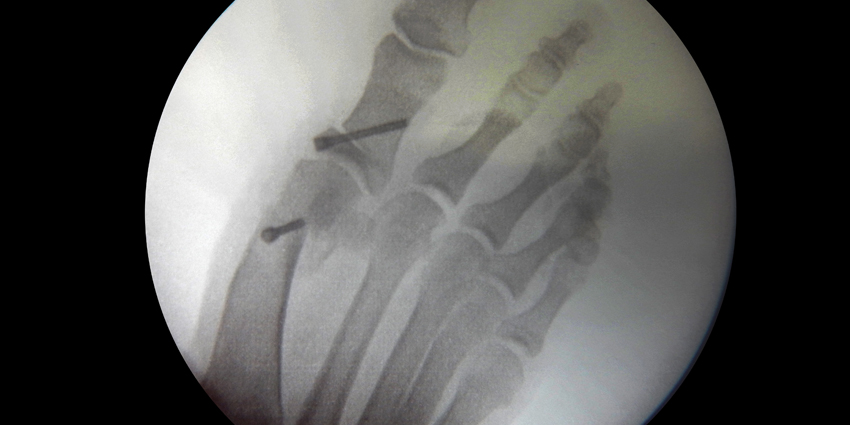
Arthrodesis—the surgical fusing of two bones at their joint to reduce pain and increase stability of the joint—is an effective way to treat hallux valgus deformity but using crossing screws is associated with a lower fusion rate, according to a new study.
Lower Fusion Rate With Arthrodesis for Bunions
1 min read Premium comments
Secondary#bunions#fusionrate#halluxvalgus
The study, “Incidence of Nonunion Following First Metatarsophalangeal Joint Arthrodesis for Hallux Valgus Deformity: A Retrospective Analysis of Four Different Constructs,” was published on January 11, 2023, online in The Journal of Foot And Ankle Surgery.
The multi-center research team (Atrium Health Wake Forest Baptist Medical Center and Southeast Permanente Foot & Ankle Trauma Reconstructive Fellowship Program) conducted a retrospective review of 166 consecutive limbs that had been treated with first metatarsal phalangeal joint arthrodesis at Wake Forest Baptist Medical Center. The surgeons performed the procedure using four different constructs for the arthrodesis.
The collected data for the incidence of nonunion, intermetatarsal correction, infection, and recurrence. Out of the 166 patients, 20 or 12% experienced a nonunion. Eighty-six percent of the patients who had received plate and screw implants achieved union while 78% of crossing screw patients achieved union. Follow-up times ranged from 3 months to 15.4 months for all patients.
The researchers calculated a mean change in intermetatarsal and hallux valgus angle correction of 3.4 and 20.3 degrees. There was no statistical difference based on hardware construct or being diabetic, they determined.
“First metatarsophalangeal joint arthrodesis is a viable option for hallux valgus. However, the results of the present study suggest that there is a lower fusion rate of the first metatarsophalangeal joint using crossing screws for bunion deformities,” they wrote.
Study authors include Brennan K. Reardon, DPM, Luke E. Leffler, DPM, Joni K. Evans, MS, Cody D. Blazek, DPM, FACFAS, Aaron T. Scott, M.D., and Dekarlos M. Dial, DPM, FACFAS, all from the Atrium Health Wake Forest Baptist Medical Center in Winston-Salem, North Carolina.
Hayden L. Hoffler, DPM, AACFAS of the Southeast Permanente Foot & Ankle Trauma Reconstructive Fellowship Program, The Southeast Permanente Medical Group in Atlanta, Georgia, also contributed to the study.
Author
React:
Discussion
This is a fascinating development. In my practice we've seen similar outcomes with the revised protocol. The key differentiator seems to be patient selection criteria. Has anyone else noticed the correlation with BMI thresholds?
Great point. I'd push back slightly on the conclusion, the sample size in the cited study is too small to draw population-level inferences. That said, the directional signal is compelling and worth a larger RCT.
We implemented a similar approach last year. Early results are promising but we're still gathering 12-month follow-up data. Happy to share our protocol if anyone is interested.
Join the conversation
Orthopedic professionals are discussing this. Sign in and upgrade to read every comment and add your voice.