
It’s easy to take things for granted sometimes…clean(ish) water will emerge from the faucet, grocery stores will have what you need, and you most likely won’t lose your job and slip into poverty because you can’t get scheduled for surgery.
The Beauty and Power of Volunteer Surgeons Far From Home
5 min read Premium comments
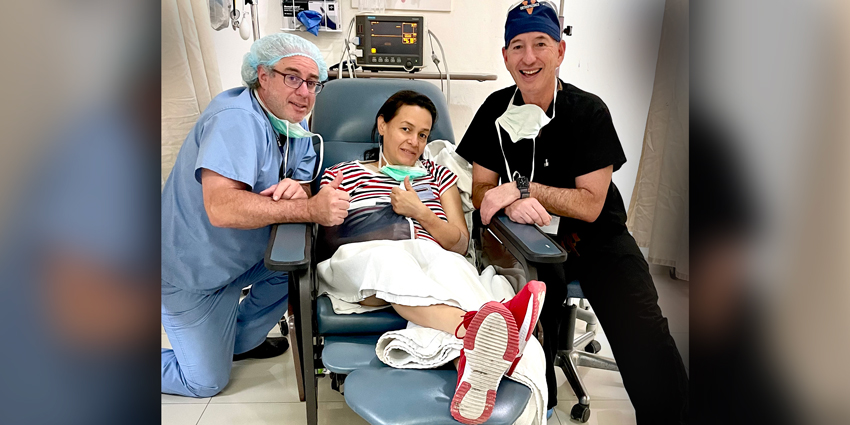
#honduras#oneworldsurgery
Due to a lack of infrastructure or other resources, however, 5 billion people around the world lack access to surgery.
For example, if you are hurting in Honduras and need orthopedic surgery, you will have to get in line behind 7,000 other people in pain. One World Surgery, an organization based in Deerfield, Illinois, is trying to change that.
Scott Sigman, M.D., a surgeon at Orthopedic Surgical Associated in Massachusetts, recently participated in a mission trip to the One World Surgery location in Honduras. Dr. Sigman tells OTW, “Surgical care is not usually a priority for underfunded health systems due to high costs and lack of supplies and surgical training. When my friend Dr. Michael Redler, who is on the board of One World Surgery, mentioned helping out in Honduras, I was quick to say ‘yes.’”
Traveling with his colleague and “right hand” nurse practitioner Kristin Proverb, Dr. Sigman made his way to the Tegucigalpa airport. “A bus picked us up and after a 2.5-hour drive, we came upon this large, enclosed campus in a beautiful setting. It was very well laid out with full plumbing and electricity. And the terrific staff cooks for everyone, largely using food generated from an onsite farm.”
“I think many surgeons are on the fence about mission work,” says Dr. Sigman. “They aren’t sure that their expertise will be useful in the ‘middle of nowhere.’ But this One World Surgery center is truly state-of-the-art with three ORs and all the equipment needed for sophisticated surgeries.”
“While there is a full-time staff onsite, those coming from the U.S. travel as a ‘brigade,’ states Dr. Sigman. “Dr. Merlin Antunez, an orthopedic surgeon, is the medical director and heads up the Honduran staff. His is a genuinely heartwarming story.”
Circle of Life
One World Surgery is situated on the premises of Nuestros Pequeños Hermanos, a site established by a charitable organization to care for Honduran children, some of whom have family and some who don’t. “Dr. Merlin grew up at Nuestros Pequeños Hermanos and then attended medical school…and is now giving back as medical director of the One World Surgery site!”
In fact, says Dr. Sigman, many of the children who grow up at Nuestros Pequeños Hermanos become leaders at One World Surgery once they turn 18. “They all learn trades and life skills…and some go on to attend law school or medical school. It’s a beautiful example of the circle of life.”
Real Grit
“In general,” comments Dr. Sigman, “medical care is lacking in Honduras and there are 7,000 people on the waiting list for surgery. These patients are the most gracious and kind people you would ever want to meet.”
And stalwart.
“As a routine, patients have to take a bus for two hours and then walk for five hours in order to get to our center,” says Dr. Sigman.
“I recall a woman in her 40s who had dislocated her shoulder approximately 20 times. She had made the two-hour bus ride and walked five hours…but we were running late in the OR. She was dehydrated and we couldn’t identify an IV access and thus couldn’t operate. We knew we couldn’t send her home, so we put our heads together and found accommodations for her to spend the night and put her first on the list for the next morning. We performed a complex arthroscopic shoulder surgery, and I am proud to say that her care was of the same quality as what someone in the U.S. would receive.”
Surgeons who donate their time see a variety of types of procedures.
“From anterior cruciate ligament (ACL) reconstruction to rotator cuff procedures to spine surgery, we see it all at this site,” says Dr. Sigman. “Any given team brings an array of sophisticated implants—sports medicine, spine, etc. And if we run out there are implants left by the brigade that came before us.”
Much as the “knee bone connected to the thigh bone,” the patient is connected to the community.
“While the vehicular trauma patients are brought to a major hospital, patients who come to One World Surgery are those in need of elective surgery that would not otherwise get done,” says Dr. Sigman. “The procedures we perform can vastly improve the quality of life of not only the patients, but their families. If the primary wage earner can’t work or walk because of severe ACL instability, then that has obvious consequences for the family—and the community that pulls together to help them. Our surgeries free them up to contribute to their families and society.”
Learning From Hondurans
Dedicated to obliterating the opioid crisis wherever he works, Dr. Sigman states, “My passion is opioid-sparing surgery. When we do procedures at One World Surgery, we use a local non-opioid anesthetic that gives patients 2-3 days of pain relief. I am hoping that the surgeons who participate in mission trips will take these lessons back to the U.S. and begin to alter their practice patterns.”

The Americans who go to Honduras are extremely grateful for the massive efforts put forth by the full-time onsite staff. “One of our lead OR managers is the go-to guy for just about everything. This man would walk two hours each way to work and then return home at night. Our brigade banded together and bought him a motorcycle…there wasn’t a dry eye in the place.”
So, what would he do with a $1 million grant to further orthopedic care in Honduras? “I would do direct marketing to communicate to orthopedic surgeons in the U.S. that this is an opportunity of a lifetime to change the fate of some very deserving people. I would develop relationships with medical device companies so that implants can be regularly donated. In addition, I would develop a training program for Honduran surgeons…oh, and a new bus! Our current one is rather dilapidated.”
As a rite of passage, all those who enter the premises must take a certain photo upon their departure. “There is a gated doorway with a sculpture of angel wings on the front door. Once we have completed our service, each of us has a picture taken in front of the angel wing doors.”
“Please,” says Dr. Sigman, “take your expertise and heal these individuals who have NO other opportunity to have their limbs and lives repaired. You don’t have to change what you do…just do it in Honduras.
For additional information, please visit https://oneworldsurgery.org
Author
React:
Discussion
This is a fascinating development. In my practice we've seen similar outcomes with the revised protocol. The key differentiator seems to be patient selection criteria. Has anyone else noticed the correlation with BMI thresholds?
Great point. I'd push back slightly on the conclusion, the sample size in the cited study is too small to draw population-level inferences. That said, the directional signal is compelling and worth a larger RCT.
We implemented a similar approach last year. Early results are promising but we're still gathering 12-month follow-up data. Happy to share our protocol if anyone is interested.
Join the conversation
Orthopedic professionals are discussing this. Sign in and upgrade to read every comment and add your voice.