
Aliso Viejo, California-based OrthAlign, Inc., the developer and manufacturer of a hand-held navigation device brand named Lantern™ for large joint surgeons has launched an additional product feature for that system which, according to Hospital for Special Surgery’s (HSS) Chief Medical Innovation Officer Michael Ast, M.D., “precisely and repeatedly measures the ligament tension of the knee to balance the knee in a manner that is both individualized for that patient and reproduceable across surgeons and sites of service.”
OrthAlign Releases New Personalized Alignment Lantern® App
2 min read Premium comments
Secondary#orthalign#lanternplatform#sagittalalignment
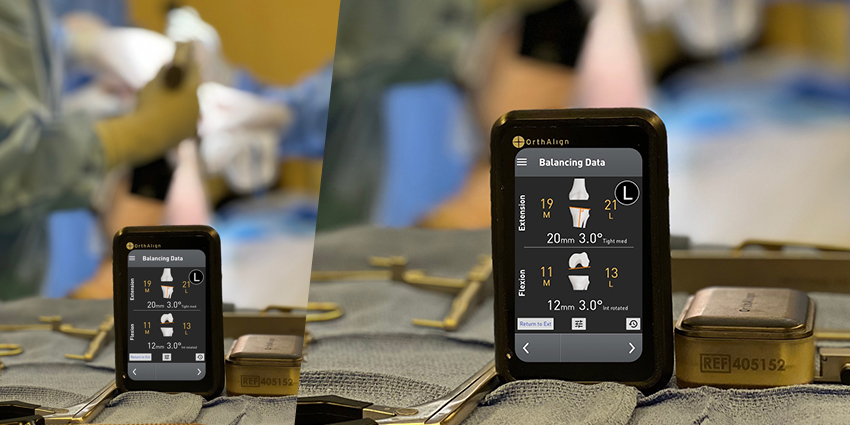
The new feature, brand named Lantern Balance, is designed for use in primary and revision knee procedures and provides the surgeon with quantitative tools for improving soft tissue balancing.
OrthoAlign released the new balance function in over ten states, meaning that surgeons now have intraoperative information on flexion and extension gaps.
“With technology becoming the standard of care in total joint replacement, delivering operationally and economically efficient technologies is key. Lantern Balance is designed to provide personalized alignment without the need for pre-operative imaging or capital equipment. Now, with Lantern, surgeons can take advanced surgical technologies to any site of service with ease,” says Eric Timko, Chairman and CEO of OrthAlign.
According to Dr. Ast, soft-tissue balancing is one of the most critical steps for a successful knee replacement.
“Determining a patient’s balance has historically relied on a surgeon’s ability and skill, which presents difficulties as it relates to reproducibility and standardization across surgeons. Modern technology, like the Lantern Balance System, now allows surgeons to more precisely and repeatedly measure the ligament tension of the knee to balance the knee in a manner that is both individualized for that patient and reproduceable across surgeons and sites of service,” Ast says.
“It is pertinent now more than ever that patients receive a high level of care from their surgeons using the most advanced technology available,” added Timko, “Lantern just got brighter with this new, cutting-edge application.”
Dr. Ast also told OTW, “An incredibly fun and interesting milestone was the development of the user interface. The 3D graphics, videos and intuitive touchscreen make the technology so much like the smartphones and other touchscreen devices we have become accustomed to using in our daily lives.”
“The other milestone would be the launch of Balance, which elevated the entire Lantern product with the capability for extremely accurate measurements on coronal and sagittal alignment. These together evolve the product into a full smart tool, providing an intuitive user experience with balance and femoral rotation to support the desired clinical outcomes.”
When OTW asked how it specifically helps with flexion and extension gaps, Dr. Ast noted, “The Balance system allows for accurate measurement of the flexion extension gaps and the overall limb alignment within your preferred personalized alignment targets. It also helps determine femoral rotation to establish an appropriately balanced flexion gap. It can be adjusted for any alignment strategy and used with any type of implant, which makes it an ideal partner for any surgical experience.”
Author
React:
Discussion
This is a fascinating development. In my practice we've seen similar outcomes with the revised protocol. The key differentiator seems to be patient selection criteria. Has anyone else noticed the correlation with BMI thresholds?
Great point. I'd push back slightly on the conclusion, the sample size in the cited study is too small to draw population-level inferences. That said, the directional signal is compelling and worth a larger RCT.
We implemented a similar approach last year. Early results are promising but we're still gathering 12-month follow-up data. Happy to share our protocol if anyone is interested.
Join the conversation
Orthopedic professionals are discussing this. Sign in and upgrade to read every comment and add your voice.