
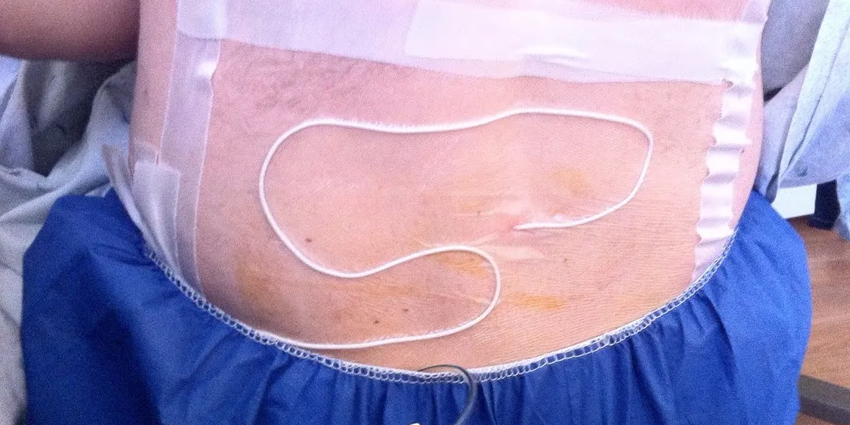
A new randomized controlled trial (RCT) study found evidence that wound drains after lumbar arthrodesis for treatment of degenerative lumbar disorders tended to increase length of hospital stay (LOS).
Wound Drains Increase Hospital LOS After Lumbar Surgery?
2 min read Premium comments
Secondary#degenerativelumbardisorders#postoperativedraims
The study, “Wound drain in lumbar arthrodesis for degenerative disorders: An experimental, multicenter, randomized controlled trial,” was published online in the December 2022 issue of The Spine Journal.
Drains are often used to decrease postoperative hematoma and wound tension after surgery, but, say the research team, there is not enough evidence available to support the use of drains to avoid complications in degenerative lumbar spine surgery.
In their multicenter randomized prospective controlled trial, the Santiago, Chile-based research team analyzed clinical outcomes, complications, hematocrit, and length of stay in the hospital in patients who received a wound drain after lumbar arthrodesis for a degenerative disorder.
All the study participants had undergone posterior lumbar decompression and fusion surgery for degenerative disorders from October 2019 to August 2021.
The patients were randomized into the drain or non-drain groups at nine hospitals. All the patients were between the ages of 40 and 80 years and were undergoing primary surgery up to three levels. Any patients with bleeding abnormalities, bleeding > 2500 ml, and dural tears were excluded from the analysis.
Outcome measures included Oswestry Disability Index, SF-36, lumbar and lower extremity Visual Analog Scale, body mass index, hematocrit, temperature, surgical time, complications, estimated blood loss, postoperative temperature and hematocrit at days 1 and 4, dressing saturation, and length of hospital stay.
The research team evaluated both groups preoperatively, perioperatively, and at the one-month follow-up. Initially, the team enrolled 100 patients in the trial and then evaluated 93 at the final follow-up. The researchers were able to randomize forty-five patients to the drain group and 48 to the non-drain group.
The team observed no differences between the two groups when it came to preoperative characteristics such as pain, hematocrit, and spine pathology. Surgical time, estimated blood loss, and complications were also similar between the two groups. There was also no difference in dressing saturation or postoperative temperature.
However, the data showed that at postoperative day 4 hematocrit was higher in the non-drain group than in the drain group (p=0.054). Additionally, the length of stay was higher in the drain group [4 (3-5) days] than in the non-drain group [3 (2-4) days] (p=0.007). The quality-of-life score, SF-36, was higher in the non-drain group [67.9 (53.6-79.2)] than in the drain group [56.7 (49.1-66)] (p=0.043).
“Based on this study, in patients undergoing primary posterior spinal decompression and fusion up to three levels for degenerative lumbar disorders, we do not recommend the use of postoperative drains,” the researchers wrote.
Study authors include Marcelo Molina of Clínica Las Condes, Instituto Traumatológico de Santiago and Finis Terrae University in Santiago, Chile; Ramón Torres of Instituto Traumatológico de Santiago and Clínica Santa Maria in Santiago; Magdalena Castro of Finis Terrae University; Lucio Gonzáles of Instituto Traumatológico de Santiago; Karen Weissman of Clínica MEDS; Maripaz Martinez of Finis Terrae University; Marcos Ganga of Clínica Santa Maria; and Roberto Postigo of Clínica Universidad de los Andes in Santiago, Chile.
Author
React:
Discussion
This is a fascinating development. In my practice we've seen similar outcomes with the revised protocol. The key differentiator seems to be patient selection criteria. Has anyone else noticed the correlation with BMI thresholds?
Great point. I'd push back slightly on the conclusion, the sample size in the cited study is too small to draw population-level inferences. That said, the directional signal is compelling and worth a larger RCT.
We implemented a similar approach last year. Early results are promising but we're still gathering 12-month follow-up data. Happy to share our protocol if anyone is interested.
Join the conversation
Orthopedic professionals are discussing this. Sign in and upgrade to read every comment and add your voice.