
A wireless surgical camera system has brought together Lazurite Holdings LLC, a medical device and technology company based in Cleveland, Ohio, and Hospital for Special Surgery (HSS), the top ranked hospital in the United States for orthopedics.
Wireless Surgical Camera Collab Between Lazurite and HSS
1 min read Premium comments
Secondary#arthrofree#lazurite
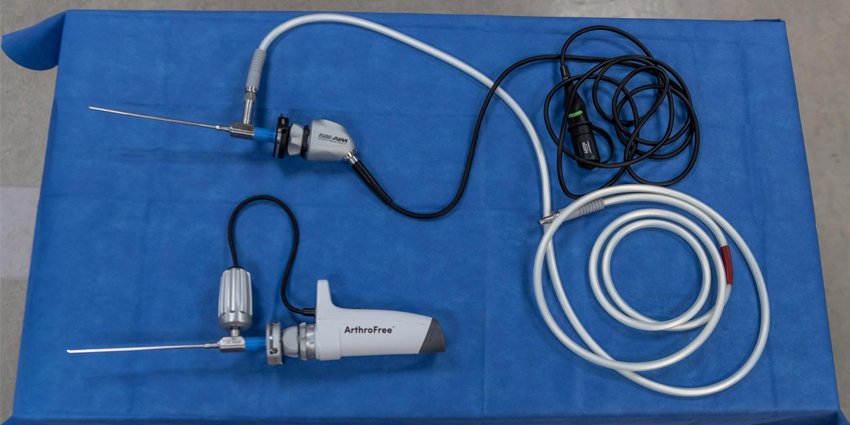
The hospital and product developer have established a collaborative relationship based on Lazurite’s ArthroFree™ Wireless Surgical Camera System. In March 2022, the ArthroFree System received FDA 510(k) clearance. According to the company, it is the first wireless surgical camera system to receive clearance for arthroscopy and general endoscopy. For more information on the 510(k) clearance, see “Cut the Cable – FDA Clears First Wireless Arthroscopy Camera.”
Lazurite President and General Counsel Leah Brownlee commented, “We’re pleased that a world-class clinical organization like HSS sees the potential for the ArthroFree System to become the standard of care in the minimally invasive OR.”
Brownlee continued, “HSS has been a pioneer in orthopedic research and innovation for decades. The hospital performs more than 32,000 surgical procedures annually, including more hip surgeries and more knee replacements than any other hospital in the country. We believe this will be a beneficial experience for both HSS and Lazurite.”
The companies are coming together in the HSS Innovation Institute. Their efforts will focus on enhancing surgical technology and techniques and providing training sessions on the technology. The collaboration may even include the co-creation of new arthroscopic technologies, incorporating both the wireless camera and Meridiem™ light technology. The proprietary light technology is “solid-state, low-heat, high-efficiency.”
HSS Chief Medical Innovation Officer and joint replacement surgeon Michael P. Ast, M.D. stated, “HSS is excited to collaborate with Lazurite to evaluate the ArthroFree Wireless Surgical Camera System, provide insights into a next generation of the existing device, and potentially co-develop other medical device products utilizing this technology.”
Author
React:
Discussion
This is a fascinating development. In my practice we've seen similar outcomes with the revised protocol. The key differentiator seems to be patient selection criteria. Has anyone else noticed the correlation with BMI thresholds?
Great point. I'd push back slightly on the conclusion, the sample size in the cited study is too small to draw population-level inferences. That said, the directional signal is compelling and worth a larger RCT.
We implemented a similar approach last year. Early results are promising but we're still gathering 12-month follow-up data. Happy to share our protocol if anyone is interested.
Join the conversation
Orthopedic professionals are discussing this. Sign in and upgrade to read every comment and add your voice.