
New retrospective research from the team at Texas Back Institute in Plano, Texas, has determined that a particular type of stand-alone anterior lumbar interbody fusion (ALIF) implant is a valid treatment with good clinical outcomes for select patients.
Study: Stand-Alone STALIF M Is a ‘Reasonable Alternative’
2 min read Premium comments
#centinelspineSecondary#texasbackinstitute#standalonestalifm
Their work, “Evaluation of Anterior Lumbar Interbody Fusion Performed Using a Stand-Alone, Integrated Fusion Cage,” is published in the International Journal of Spine Surgery.
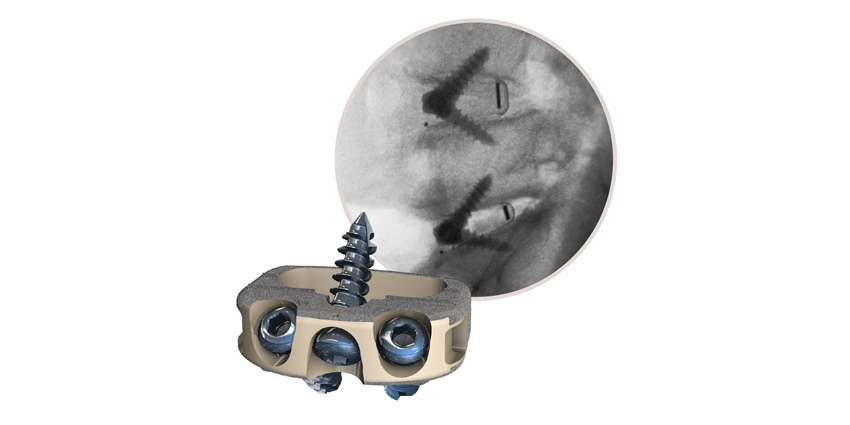
The implant used in the study was the stand-alone STALIF M Integrated Interbody (manufacturer: West Chester, Pennsylvania-based Centinel Spine, LLC). The Texas Back team reviewed data from 58 consecutive patients from March 2011 to December 2018.
Each patient reported outcome score improved significantly, including Oswestry Disability Index (41.7 preop vs 21.0 at follow-up), Visual Analogue Scale back (6.0-2.5) and leg pain (4.1-1.3).
“The STALIF M-Ti titanium-coated PEEK cage with integrated screws provides a stable construct, encouraging rapid fusion incorporation. The results of this study further support what I’ve seen clinically for many years, which is good outcomes from stand-alone ALIF for treating painful disc degeneration resistant to non-operative care,” commented Scott L. Blumenthal, M.D.
“This study is significant because it supports the use of stand-alone ALIF as a valid treatment option that leads to good clinical outcomes for select patients undergoing spinal fusion,” said Jessica Shellock, M.D.
“Stand-alone ALIF is a very reasonable alternative to consider for patients who don’t require an additional posterior surgery due to instability or severe neural compression and avoids the risks and cost associated with posterior instrumentation.”
As for the most impressive thing to emerge from this study, Richard Guyer, M.D. told OTW, “Stand-alone cages are a viable, reliable and less invasive solution to some degenerative disc conditions with the added benefit of being able to the see a fusion with this simple peek and titanium implant.”
“It has a long track record as an anatomic integrated ALIF implant that can be used as a stand-alone device. I like that the STALIF M-Ti has an advanced titanium coating with a modulus of elasticity similar to bone, which minimizes subsidence. I have been extremely happy with its performance,” said Dr. Guyer.
“The STALIF M has been my ‘go-to’ stand-alone ALIF implant-of-choice for many years,” said Jack Zigler, M.D. “It has a good range of sizes and lordotic angles and has been consistently hassle-free in using the variable-angle screwdriver and self-tapping screws. After a tough decompression and mobilization, it’s great to know that the implantation itself will be straightforward and will not introduce new problems at the end of the case,” he concluded.
Author
React:
Discussion
This is a fascinating development. In my practice we've seen similar outcomes with the revised protocol. The key differentiator seems to be patient selection criteria. Has anyone else noticed the correlation with BMI thresholds?
Great point. I'd push back slightly on the conclusion, the sample size in the cited study is too small to draw population-level inferences. That said, the directional signal is compelling and worth a larger RCT.
We implemented a similar approach last year. Early results are promising but we're still gathering 12-month follow-up data. Happy to share our protocol if anyone is interested.
Join the conversation
Orthopedic professionals are discussing this. Sign in and upgrade to read every comment and add your voice.