
The U.S. Food & Drug Administration (FDA) has granted 510(k) clearance to a novel hand-held spine surgery navigation device.
Hand-held Spine Surgery Navigation Device Gets 510(k) Clearance
1 min read Premium comments
Secondary#boltnavigationsystem#bolt#circinusmedicaltechnology
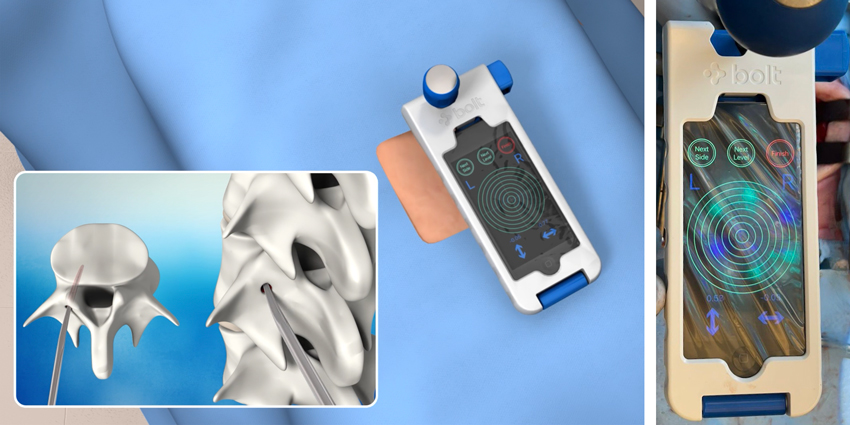
According to the 510(k) summary, the hand-held navigation system provides “navigational guidance during spine surgery.” It includes an iPod touch® mobile digital device loaded with the system’s navigation software, a single use case, and sterile drape.
Brand named Bolt™ Navigation System, the “smart” device is indicated for use to assist spine surgeons “in the accurate placement of pedicle screws when used in conjunction with an intraoperative fluoroscope. It utilizes intraoperative fluoroscopic and pre-operative MRI or CT axial images to provide surgical planning and navigational telemetry relative to gravity, based on a fixed entry point ascertained by the user and validated by intraoperative fluoroscopic imaging. It is not intended to track patient position.”
Additionally, “The System is indicated for open and minimally invasive pedicle screw placement using a posterior approach in the thoracolumbar and sacral spine (T-9 to S1) where the patients’ relevant rigid anatomical structures can be clearly identified on the imaging.”
The system, the Bolt™ Navigation System, received clearance based on a predicate device, the TrackX v.2.0, an image-intensified fluoroscopic X-ray system. The Augmedics xvision Spine System and the Medtronic StealthStation are reference devices.
Circinus Medical Technology, LLC, a developer of handheld surgical navigation systems, submitted the application. John K. Dorman, M.D., a neurosurgeon, programmer, and founder of Circinus, developed the Bolt ™ Navigation System.
According to the company, “The Bolt ™ Navigation System offers a remarkably accurate, easy to use, economic spine navigation solution. It utilizes an iOS device, with its high-powered processor, familiar user interface, and highly sensitive gyroscope-on-chip™ technology to support the efficient and effective placement of posterior spine fixation.”
Additionally, “Its near zero footprint, instrument agnostic design, ability to utilize standard imaging, and subscription business model makes it ideal for today’s evolving surgical market.”
Finally, in 2020, the Bolt System won Orthopedics This Week’s annual Best Technology in Spine award.
Author
React:
Discussion
This is a fascinating development. In my practice we've seen similar outcomes with the revised protocol. The key differentiator seems to be patient selection criteria. Has anyone else noticed the correlation with BMI thresholds?
Great point. I'd push back slightly on the conclusion, the sample size in the cited study is too small to draw population-level inferences. That said, the directional signal is compelling and worth a larger RCT.
We implemented a similar approach last year. Early results are promising but we're still gathering 12-month follow-up data. Happy to share our protocol if anyone is interested.
Join the conversation
Orthopedic professionals are discussing this. Sign in and upgrade to read every comment and add your voice.