
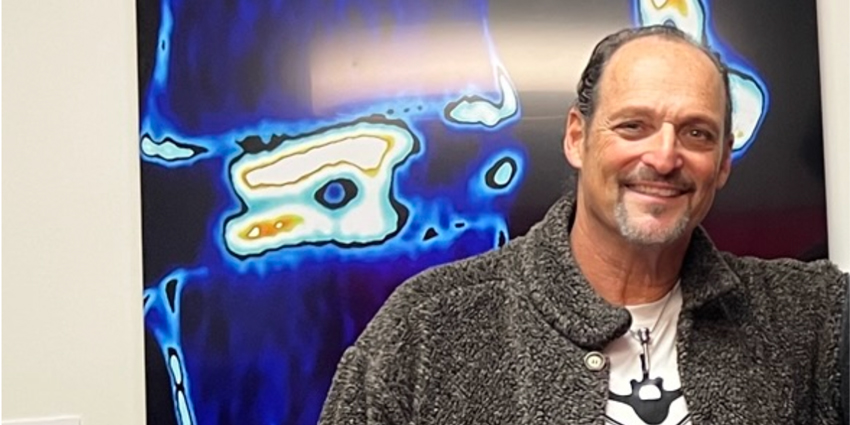
He is a spine surgeon, entrepreneur, and storyteller. He is an OR maestro-turned-digital artist. Whether conducting a symphony in the operating room or on a digitized image, Gil Tepper, M.D. is now crafting an artistic life where he sees possibilities all around him.
Gil Tepper, M.D.: A Wellspring of Art and Inspiration
6 min read Premium comments
#giltepper#orthopedicart
While Dr. Tepper still practices medicine part time as a concierge consultant, he uses his art as a platform to connect personally with people. “We all have life- and health-related challenges,” said Dr. Tepper to OTW. “I am inspired when discussing art with someone leads to a conversation about where they are in life. It is an honor for me to be part of their journey.”
The Inspirations
The descendant of Holocaust survivors, Gil Tepper says that what got his grandfather and mother through the worst times was creative expression. “For my grandfather it was studio photography in Poland, while for my mom, a 9-year-old Jewish girl, it was her creativity and ability to mimic her Christian friends in prayer during raids.”
Dr. Tepper says he has always leaned toward abstract expression/art. “Even when I was a research student in the late 1970s, I spent my spare time playing with organic compound crystals under polarized light microscope. The results were these amazing colorful formations—for the active mind this meant the viewer would see something in the abstraction.
“Just by choosing an area on the slide and changing the light polarization I could get different color palettes and formations, which I would then develop into a finished painting or print. In the past I would print out a photo of the crystals and then cut around certain elements in the image and mount this portion in 3D, the result being that the crystals would pop out of the photo.”

Years later he is working similarly with digital X-rays. “I select a certain area of the black and white X-ray and play with the magnification until I get a pattern I want. Then I play with the color based on my mood and emotions until the composite image is pleasing to my eye.
Throughout his residency, Gil Tepper experimented with artistic outlets. “I was particularly fascinated with implant designs and materials,” he commented to OTW, “and during residency early practice I created multimedia sculptures using extricated implants

Experimenting With Artistic Processes
Since 2009 Dr. Tepper has created hundreds of digital images from realistic to abstract. “I have recently built a 2D/3D website that is a complete gallery experience. (www.Nifteart.com) ‘The Gillery’ as I call it, has music and is a gamified website where viewers can ‘walk around’ and actually see the art. Creating this site has been its own stimulating learning experience using lots of different forms of technologies.”
“Now I print on metal and mount the piece afloat and away from the wall,” stated Dr. Tepper to OTW. “Some of my current work involves using radiograph imperfections to elevate the art. So, things on X-rays such as artifact and distortions, i.e., X-rays considered poor for diagnostic purposes, actually enhance digital processing.”
As for how he begins a piece, Dr. Tepper explained, “I find a digital X-ray file that has something interesting—either about the anatomy, the surgery or the patient’s story. When I look at these surgical X-rays, they bring back memories of the person’s story. Some of these cases were big surgeries requiring a huge team of various specialists contributing their respective talents. In the end, you have an X-ray that tells a story about a person whose life was halted due to an injury and how we all helped put that life back together.”

“I use several software packages for the special effects. Once I choose an area, I begin by processing the contrast and magnification patterns and then continue working in layers to enhance various aspects. It’s very meditative and therapeutic. Sometimes I zoom in to such a high magnification that all I see is patterns. I get lost, which is ultimately good for my artistic process.”
And how does he know when it’s done? “I basically get a dopamine hit saying, ‘this is it.’ The color palette, shapes, and the message all come together.”
How Art and Surgery Come Together
Dr. Tepper: “As an early proponent of minimally invasive surgery, it is inspiring to see that younger surgeons are pushing our field to a level where we do more with less tissue stripping, less scarring, and reduced blood loss.”
When OTW asked what he thinks younger surgeons need to know, Dr. Tepper stated, “They need to remember that 95% of their headaches come from 5% of their practice. Surgeons typically don’t want to look at that 5%.”
“Part of what we try to ignore is looking closely at how our work affects us. I try to use my art to increase awareness of the importance of personal well-being. First, radiation safety awareness is critical because so many doctors have had side effects from being exposed in the OR over the years. In addition, we need to establish mentorship as something that is expected. Someone who has a different outlook can offer a sounding board and support—we don’t need to go it alone.”
Walking the Walk
Gil Tepper is true to his word and continues to mentor physicians who are undertaking the recertification process. “After roughly 10 years in practice, surgeons are starting to have ‘battle scars’ such as family issues, poor time management or financial problems, etc., all of which may interfere with how they prepare for recertification. I try to help by creating a structure and program for preparation, practice, and mock exams for active case review. We talk openly about the challenges and frustrations we all experience and find mutual support in the process.”
Launching the Future
Dr. Tepper has recently curated his first art exhibit, held November 19, 2022, in Santa Monica. A jazz pianist, he is now ready to take things to the next level. “Through collaboration with musicians, I am in the process of adding music to the digital photos, essentially creating an original sound riff for each piece.”
The needs of others are never far from the mind of Gil Tepper. “I am trying to deepen my collaborations and am now working with a charity in Mexico where art therapists help autistic children. The foundation is building a new hospital for children—a comprehensive facility with advanced rehabilitation techniques. For those in a remote area, donors have gifted the families with computers so the art therapist can work with the children virtually. I am participating by sharing a remote platform with a digital anatomic trove of anonymous images as a starting point for collaboration.”
Still in touch with some former patients, Dr. Tepper told OTW, “Some of the patients I once operated on benefit from artistic expression. I teach them and others how to collaborate on my platform while sharing a part of my proceeds to disabled artist fund and also radiation safety research.”

Favorite Piece of Art
Unlike some artists who can’t choose between their “artistic babies,” Dr. Tepper does indeed have a favorite piece: Blue Disco. “OK, well it’s in my top five favorite because of the color and the controversy. It is made from a discogram, a tool that has been in and out favor among spine surgeons.”
“This is a very rewarding time for me,” said Dr. Tepper to OTW. “The creative flow and process brings a true sense of accomplishment, as does being able to connect with people and have calm, slow conversations about life, as well as physical and emotional challenges. I couldn’t ask for anything better.”
Author
React:
Discussion
This is a fascinating development. In my practice we've seen similar outcomes with the revised protocol. The key differentiator seems to be patient selection criteria. Has anyone else noticed the correlation with BMI thresholds?
Great point. I'd push back slightly on the conclusion, the sample size in the cited study is too small to draw population-level inferences. That said, the directional signal is compelling and worth a larger RCT.
We implemented a similar approach last year. Early results are promising but we're still gathering 12-month follow-up data. Happy to share our protocol if anyone is interested.
Join the conversation
Orthopedic professionals are discussing this. Sign in and upgrade to read every comment and add your voice.