
Grenoble, France-based eCential Robotics, a surgical robotics company, has entered into a long-term collaboration agreement with Geneva, Switzerland-based Spineart, a privately held medical device company that produces spine surgery implants.
eCential Robotics and Spineart Announce Partnership
1 min read Premium comments
Secondary#ecentialrobotics#spineart
Through the partnership, the companies will focus on the research and development, marketing, and commercialization of spine surgery technologies and products. In the coming year, spine surgeons in the United States and Europe will have access to training centers for an augmented spine surgery trial.
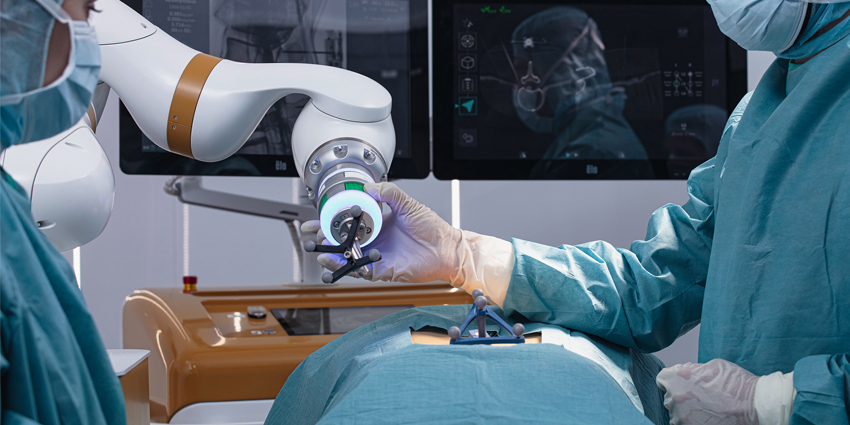
According to eCential, “With a streamlined workflow and a smartphone-inspired user interface, spine surgeons will benefit from eCential Robotics’ state-of-the-art integrated platform, fully compatible with Spineart’s comprehensive and proven portfolio of innovative spine implants.”
OTW spoke with eCential Robotics CEO Stéphane Lavallée about the partnership’s goals for the upcoming year. Lavallée told OTW, “In 2023, Spineart and eCential Robotics intend to start surgical activity in the US at a selected pilot hospital. Spine surgeons at this site will be able to use Spineart surgical solutions while leveraging eCential Robotics’ FDA-approved low-dose 3D imaging, navigation and robotic guidance system.”
Lavallée continued, “Spineart will also start developing proprietary innovations on the open eCential platform.”
eCential Robotics is the creator of an open system that brings together 2D/3D robotic imaging and real-time surgical navigation. eCential Robotics will work with Spineart in all efforts to bring the collaboration of its robotic guidance system and Spineart’s spine implants to spine surgeons.
Spineart CEO Jerome Trividic commented, “There’s a strong cultural and geographical fit between our companies. Combining and leveraging eCential Robotics’ technology in navigation and robotics with Spineart’s expertise in minimally invasive spine surgery, is the ultimate expression of our Quality, Innovation, Simplicity philosophy.”
Trividic continued, “We strongly believe that our combined efforts will rapidly establish the integrated platform as the reference in augmented spine surgery with navigation and robotic assistance.”
Author
React:
Discussion
This is a fascinating development. In my practice we've seen similar outcomes with the revised protocol. The key differentiator seems to be patient selection criteria. Has anyone else noticed the correlation with BMI thresholds?
Great point. I'd push back slightly on the conclusion, the sample size in the cited study is too small to draw population-level inferences. That said, the directional signal is compelling and worth a larger RCT.
We implemented a similar approach last year. Early results are promising but we're still gathering 12-month follow-up data. Happy to share our protocol if anyone is interested.
Join the conversation
Orthopedic professionals are discussing this. Sign in and upgrade to read every comment and add your voice.