
No set screw loosening. No rod bending. Seventy-nine percent reduction in construct bulk.
Truly Novel Posterior Lumbar Fixation System Launched
2 min read Premium comments
Secondary#nexusspine#patientspecificrods#presson
A truly novel posterior lumbar fixation system that provides motion and force transmission through bending as opposed to sliding, may well represent one of the most innovative approaches to spine internal fixation in years, is undergoing a full commercial launch.
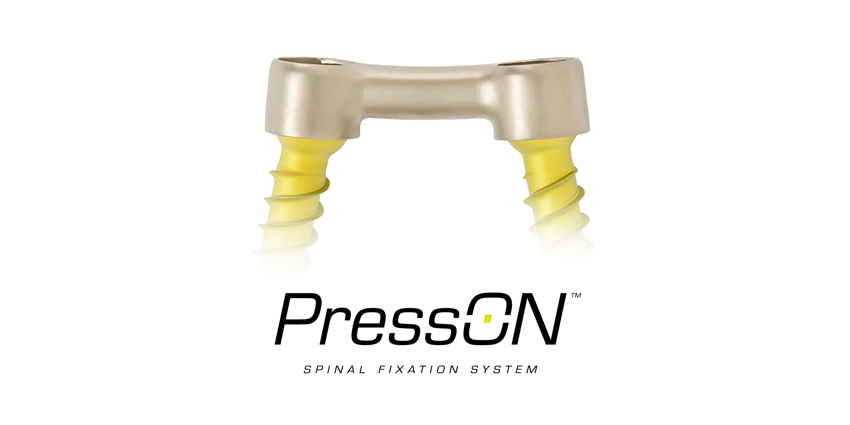
The system uses flexible bores that are stretched over pedicle screw heads during implantation, with no need for traditional set screws.
Brand named, “PressON” this posterior lumbar fixation system is 1/4th the size of traditional systems. According to the manufacturer (Nexus Spine, LLC), it is also faster to implant, biomechanically stronger, and removes any possibility of set screw loosening. Finally, according to Nexus Spine, the PressON system allows for intraoperative construction of patient-specific rods.
Thomas Sweeney, II, M.D., Ph.D., the surgeon designer of the system, explained the significance of this new approach to spine fixation saying, “There hasn’t been meaningful innovation in non-deformity posterior fixation technologies in a very long time. PressON is unlike anything else on the market in the way that the components are connected.”
“Not only does it result in a construct that is smaller, stronger, and faster to implant, but it is also unique in its ability to create patient-specific multilevel rods intraoperatively. As a result, it eliminates the need for rod bending and the pain associated with improperly bent rods and rod creep.”
“PressON is uniquely poised to disrupt the posterior lumbar fixation market that has long been mired by a lack of differentiation.”
“Our expertise in compliant mechanism engineering allows us to do some really unique things,” explained Nexus Spine President David Hawkes. “The ability to secure PressON rods through elastic interference rather than using set screws is certainly a paradigm shift.”
“We are in the process of shining a light on the incidence and harmful effects of set screw loosening through clinical and benchtop research. We look forward to sharing the results of these studies soon.”
“Once the original ‘555 set screw patent expired, there was an industry-wide rush to copy that traditional tulip design because it was easy to use and cheap to make,” said Hawkes to OTW. “Furthermore, there was substantial risk and difficulty in trying to innovate and prove that there might be a better way. Our research found that set screws loosen and cause construct instability. That led us to use our expertise in compliant mechanism engineering to develop PressON that eliminates set screws.”
“One of the most satisfying parts of a surgeon’s first single-level PressON surgery is to hear them say things such as, ‘That’s it?! Am I really done? That easily saved me 15 minutes!’ Their speed then tends to increase with experience and additional levels.”
When OTW asked how much stronger PressON is, Hawkes stated, “PressON is much stronger in all modes of loading, which makes it very attractive for spondy reductions. However, what matters more is what PressON solves. Set screw loosening is eliminated. Rod bending is eliminated. Construct bulk is decreased by >70%. Those are all identified in peer reviewed published literature as sources of post operative pain.”
Author
React:
Discussion
This is a fascinating development. In my practice we've seen similar outcomes with the revised protocol. The key differentiator seems to be patient selection criteria. Has anyone else noticed the correlation with BMI thresholds?
Great point. I'd push back slightly on the conclusion, the sample size in the cited study is too small to draw population-level inferences. That said, the directional signal is compelling and worth a larger RCT.
We implemented a similar approach last year. Early results are promising but we're still gathering 12-month follow-up data. Happy to share our protocol if anyone is interested.
Join the conversation
Orthopedic professionals are discussing this. Sign in and upgrade to read every comment and add your voice.