
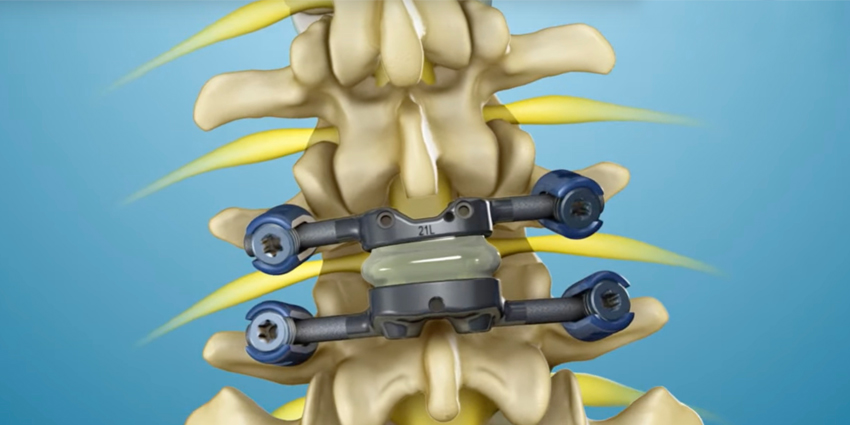
A new peer reviewed study, which appeared in the July 22, 2022, edition of Operative Neurosurgery, looks at the effects of facet replacement surgery to treat spondylolisthesis and/or stenosis, stabilize the spine, reduce pain while simultaneously avoiding adjacent segment disease. The work is titled “Mobility-Maintaining Facet Arthroplasty of the Lumbar Spine With the Second-Generation TOPS System: A Case Series.”
New Study Examines Facet Replacement for Spondy, Stenosis
3 min read Premium comments
Secondary#lumbarspinalstenosis#premiaspine#spondylolisthesis
The Vienna, Austria based research team, led by co-author Werner Lack, M.D. of Arbeitsgemeinschaft Freier Wirbelsäulenchirurgen collected data from 17 patients who had received a second generation facet replacement system post-laminotomy (manufacturer was Israeli based Premia Spine). Data was collected over the course of, on average, 51 months using a Visual Analog Scale while also calculating range of motion for each patient.
According to the research team, patients reported an average reduction in Visual Analog Scale scores of 7.5 at three months, 6.8 at 12 months, and 6.7 at the longest follow up (average improvement of 81%). The preoperative and postoperative average range of motions (ROMs) at the index level were 8.2 degrees and 7.4 degrees, respectively.
OTW asked Dr. Lack how this facet replacement device is able to achieve such close-to-normal range-of-motion scores while still avoiding adjacent segment disease. Dr. Lack explained, “Published biomechanical studies confirm that this facet replacement device maintains not only normal range of motion but also the quality of motion at the index level, while reducing peak stresses on the pedicle screws.”
“It is well documented that when one or more segments are immobilized by a fusion, the stress and demands resulting from regular activity (bending, lifting, etc.) increase at the levels above and below to compensation for the rigid segment. This can accelerate the degenerative cascade. The early randomized clinical outcomes of facet replacement versus fusion demonstrate an early advantage to facet replacement on reduced adjacent segment disease.”
Also, say the authors, the facet replacement device they tested was the first to allow patients to settle into their own natural sagittal balance.
As for why facet replacement appears to achieve these results, Dr. Lack said, “The facet replacement device we used does not ‘create’ motion. Nor does it off-load the spine. Rather, the device is there to constrain motion and share the body’s load with the anterior disc.”
“In the native spine, it is the disc that carries most of our load, while the facet joints are there to constrain the motion and thus protect our nerve roots and the central canal. Inside the facet replacement device we used are a series of sophisticated stoppers that recreate the function of the facet joint; namely, to provide constrained motion in flexion, extension, lateral bending, axial rotation, and sagittal translation.”
“Therefore, once the decompression of the diseased native facets is performed and the segment is released, the spine will naturally settle into its preferred (and now less painful) position as the patient returns to normal activities.”
Time to Consider Facet Replacement?
“I want to tell other surgeons that, in our experience, we found, for the first time, an implant which for certain indications (e.g., spondylolisthesis, stenosis) can restore the mobility of the spinal segment with a good lordosis and therefore can prevent or at least delay adjacent disc disease,” Dr. Lack told OTW.
OTW also spoke with the manufacturer and developer of the facet replacement system, Premia Spine CEO Ron Sacher. He said, “Our goal remains to deliver an implant that allows patients to retain the natural motion of their spine with less pain. These data bolster our case for TOPS™ (the system’s brand name) as a new treatment paradigm for patients suffering from these diseases.”
We further noted that this particular facet replacement system, Premia Spine’s TOPS™ facet replacement system, obtained Breakthrough Device Designation from the FDA in 2021, although it is not yet approved for use in the United States.
Author
React:
Discussion
This is a fascinating development. In my practice we've seen similar outcomes with the revised protocol. The key differentiator seems to be patient selection criteria. Has anyone else noticed the correlation with BMI thresholds?
Great point. I'd push back slightly on the conclusion, the sample size in the cited study is too small to draw population-level inferences. That said, the directional signal is compelling and worth a larger RCT.
We implemented a similar approach last year. Early results are promising but we're still gathering 12-month follow-up data. Happy to share our protocol if anyone is interested.
Join the conversation
Orthopedic professionals are discussing this. Sign in and upgrade to read every comment and add your voice.