
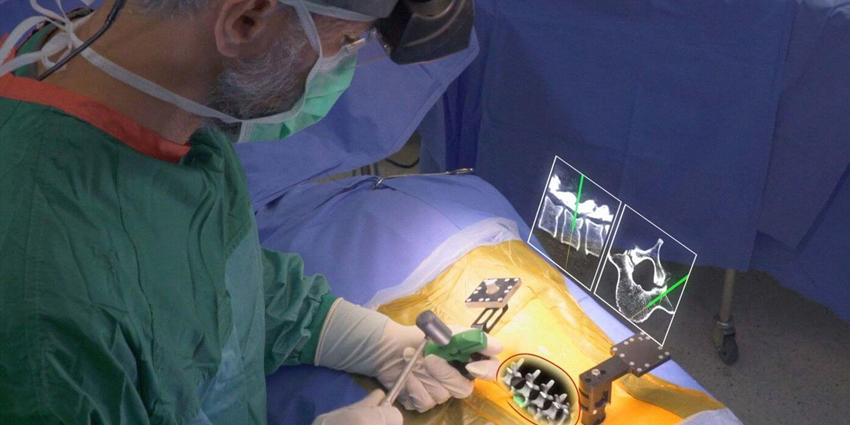
A new Rush University Medical Center study has collected data regarding the effects of using Augmented Reality tools as an adjunct to pedicle screw placement during surgery.
How Fast or Accurate Is Screw Placement Using Augmented Reality?
2 min read Premium comments
Secondary#pediclescrewplacement#augmentedreality
The study, “Augmented Reality in Minimally Invasive Spine Surgery: Early Efficiency and Complications of Percutaneous Pedicle Screw Instrumentation,” was published on September 28, 2022 in The Spine Journal.
“In general, pedicle screw accuracy rates have improved with increasingly use of technology with navigation-based instrumentation described as accurate in 89-100% of cases. Emerging Augmented Reality technology in spine surgery builds upon current spinal navigation to provide three-dimensional imaging of the spine and powerfully reduce the impact of inherent ergonomic and efficiency difficulties,” the researchers wrote.
Augmented Reality systems typically feature a wireless headset with transparent near-eye display which projects intra-operative 3D imaging directly onto the surgeon’s retina.
To study the effectives of Augmented Reality, three senior surgeons at two institutions used it for the placement of percutaneous pedicle screw instrumentation with spinal navigation in 164 total minimally invasive surgeries.
One hundred and fifty-five of the procedures were performed for degenerative pathology, 6 for tumor and 3 for spinal deformity. A total of 606 pedicle screws were placed, 590 in the lumbar spine and 16 in the thoracic spine.
The researchers analyzed patient demographics, surgical metrics including total posterior construct time, clinical complications, and instrumentation revision rates.
The time elapsed from registration and percutaneous approach to final screw placement averaged 3 minutes and 54 seconds per screw. Surgical times were similar for both the early and later cases when the surgeons had more experience with the system. None of the instrumentation needed to be revised for either clinical or radiographic complications at a follow-up ranging from 6-24 months.
A total of 3 screws were replaced intra-operatively, the researchers noted, and no radiculopathy or neurologic deficit postoperatively was reported.
The researchers noted that this is the first report of the use of Augmented Reality for placement of spinal pedicle screws using minimally invasive surgery, and that it confirms the efficiency and safety of using the technology for these procedures.
The study authors included Alexander J. Butler, M.D., Matthew Colman, M.D., and Frank M. Philips, M.D., all of Rush University Medical Center in Chicago, Illinois. James Lynch, M.D., of Spine Nevada, Reno, Nevada also contributed to the study.
Author
React:
Discussion
This is a fascinating development. In my practice we've seen similar outcomes with the revised protocol. The key differentiator seems to be patient selection criteria. Has anyone else noticed the correlation with BMI thresholds?
Great point. I'd push back slightly on the conclusion, the sample size in the cited study is too small to draw population-level inferences. That said, the directional signal is compelling and worth a larger RCT.
We implemented a similar approach last year. Early results are promising but we're still gathering 12-month follow-up data. Happy to share our protocol if anyone is interested.
Join the conversation
Orthopedic professionals are discussing this. Sign in and upgrade to read every comment and add your voice.