
A tendon repair system for lacerations in the hand, wrist, and forearm has received FDA 510(k) clearance.
FDA Clears New Extremity Tendon Repair System
2 min read Premium comments
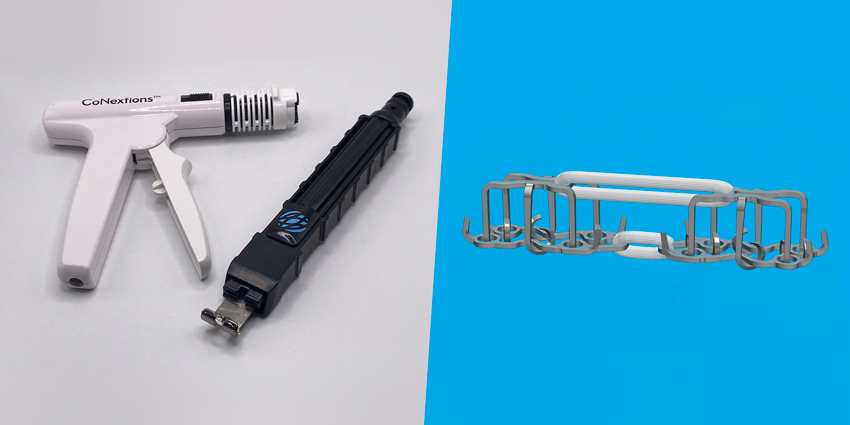
#fda510kclearanceSecondary#conextions#conextionstr
According to the manufacturer, the system is a “single-use, sterile implant consisting of two identical stainless steel anchors implanted in either end of the injured tendon which are connected by two loops of ultra-high tenacity polyethylene yarn that span the injury site.”
The system is intended for the repair of specific lacerated or severed tendons in adults (22 years of age or older).
To use the system, a surgeon first confirms “good apposition of the two ends of a lacerated tendon.” The surgeon then “staples the implant into position using specially designed single-use instrumentation.”
Traditional tendon repair relies on sutures. According to the manufacturer, CoNextions Inc.. In contrast, this system (brand named CoNextions TR® Tendon Repair System) “provides a repair that is twice as strong as the traditional suture repair, offers 2.2 times smoother tendon gliding post repair versus suture repairs, and is more than three times faster to perform than suture repair.”
OTW spoke with CoNextions Medical President and CEO Dan Gruppo. Gruppo told OTW, “We’re fortunate at CoNextions Medical to have conducted a clinical study supporting the safety and efficacy of the CoNextions TR Tendon Repair System and believe the high quality clinical evidence is helping to fuel the early clinical adoption that we are seeing both in the US and beyond.”
Gruppo continued, “While our commercial team is focused on making the product available today, our regulatory team is busy preparing a study that will potentially demonstrate superiority of the system compared to suture repairs. We are also planning to meet with the FDA to discuss a submission to support indications in foot and ankle.”
Since its clearance, the device has been used in a number of surgeries, including zone 2 flexor tendon repair in the little finger; revision surgery following a ruptured suture repair; and a triple zone 2 flexor tendon repair in three adjacent fingers.
The first surgery after the FDA 510(k) clearance was performed by Las Vegas, Nevada-based hand surgeon, Colby Young, M.D. According to Dr. Young, “After reviewing the data from CoNextions’ clinical trial, I felt confident that the CoNextions TR System was a better alternative to suture for my patient.”
Dr. Young continued, “I was also excited to see how much easier the device was to use compared to tying a complex suture knot that creates more bulk in the repaired tendon.”
CoNextions is currently focused on its sales and marketing efforts for its tendon repair system. This includes getting approval from the hospital value analysis committees and training its salesforce to facilitate clinical adoption. Most recently, the company completed its national sales training with 32 independent distributors/sales reps. Training included a cadaver lab and product demonstration.
Author
React:
Discussion
This is a fascinating development. In my practice we've seen similar outcomes with the revised protocol. The key differentiator seems to be patient selection criteria. Has anyone else noticed the correlation with BMI thresholds?
Great point. I'd push back slightly on the conclusion, the sample size in the cited study is too small to draw population-level inferences. That said, the directional signal is compelling and worth a larger RCT.
We implemented a similar approach last year. Early results are promising but we're still gathering 12-month follow-up data. Happy to share our protocol if anyone is interested.
Join the conversation
Orthopedic professionals are discussing this. Sign in and upgrade to read every comment and add your voice.