
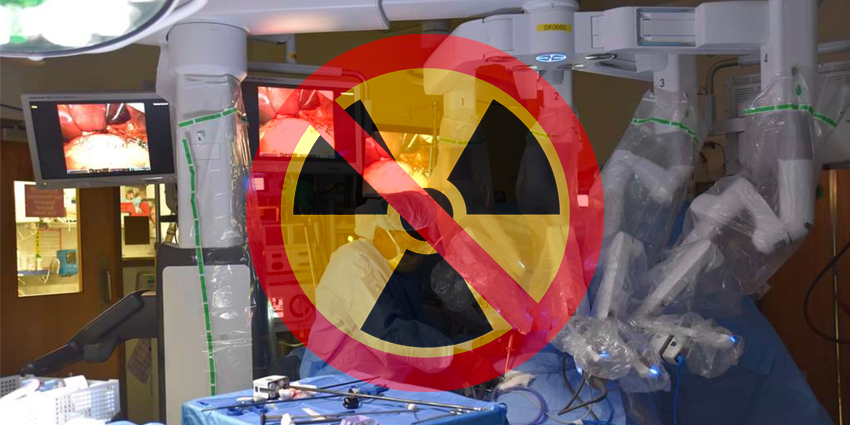
Radiation exposure during minimally invasive lumbar fusion is a concern for both patients and surgeons. A new study suggests than using robotics instead of navigation to guide the procedure could reduce the exposure.
Robotics Reduces Radiation Better Than Navigation?
2 min read Premium comments
Secondary#radiationexposure#navigation#robotics
“Although various studies have been conducted to demonstrate the benefits of both navigation and robotics over fluoroscopy in terms of radiation exposure, literature is lacking in studies comparing robotics versus navigation,” the researchers wrote.
The study, “Robotics Reduces Radiation Exposure in Minimally Invasive Lumbar Fusion Compared With Navigation,” was published online on September 15, 2022, in the journal Spine.
Conducted at the Hospital for Special Surgery in New York, it compared robotics and navigation for minimally invasive elective lumbar fusion in terms of radiation exposure and time demand in a retrospective cohort.
All procedures were performed by a single surgeon either using navigation or robotics. The navigation-assisted surgeries happened between 2017 and 2019, while the robotics-assisted surgeries occurred between 2019 and 2021. All the surgeries had the intraoperative computed tomography workflow.
The two cohorts were compared for radiation exposure [fluoroscopy time and radiation dose: image capture, surgical procedure, and overall) and time demand (time for setup and image capture, operative time, and total operating room time].
Overall, there were 244 patients included in the study. Total fluoroscopy time, total radiation dose and percentage of radiation for surgical procedure were all significantly less with robotics compared with navigation (20 vs.25 s; p < 0.001; 38 vs. 42 mGy, p +0.05; 58% vs.65%; p = 0.021).
Although the time for setup and image capture was less with robotics, but operative time more, there was no significant difference in the total operating room time. Findings were similar for both single level and two-level transforaminal lumbar interbody fusion.
“Robotics for minimally invasive transforaminal lumbar interbody fusion, compared with navigation, leads to a significant reduction in radiation exposure both to the surgeon and patient, with no significant difference in the total OR time,” the researchers wrote.
Study authors included Pratyush Shahi, M.B.B.S, M.S. (Ortho), Avani Vaishnav, M.B.B.S, Kasra Aragh, B.S., Daniel, B.S., Junho Song, B.S., Sidhant Dalal, B.S., Dimitra Melissaridou, M.D., Eric Mai, B.S., Marcel Dupont, B.S., Evan Sheha, M.D., and James Dowdell, M.D., all of the Hospital for Special Surgery in New York. Sravisht Iyer, M.D., and Sheeraz A. Qureshi, M.D., M.B.A, from both the Hospital for Special Surgery and Weill Cornell Medical College in New York also contributed to the study.
Author
React:
Discussion
This is a fascinating development. In my practice we've seen similar outcomes with the revised protocol. The key differentiator seems to be patient selection criteria. Has anyone else noticed the correlation with BMI thresholds?
Great point. I'd push back slightly on the conclusion, the sample size in the cited study is too small to draw population-level inferences. That said, the directional signal is compelling and worth a larger RCT.
We implemented a similar approach last year. Early results are promising but we're still gathering 12-month follow-up data. Happy to share our protocol if anyone is interested.
Join the conversation
Orthopedic professionals are discussing this. Sign in and upgrade to read every comment and add your voice.