
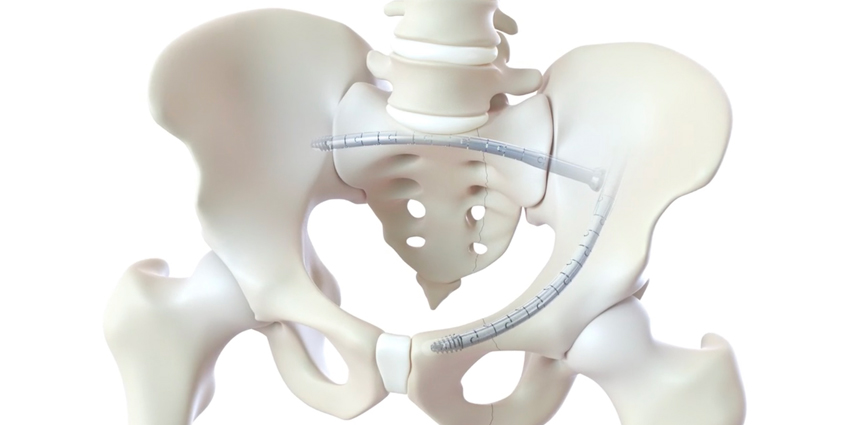
The body has no straight lines. Finally, surgeons who need to stabilize pelvic fractures have a curved intramedullary nail available—one that has now been implanted in more than 100 patients.
Novel Curved IM Implant Used in 100th Pelvic Fracture Patient
2 min read Premium comments
Secondary#curvafix#curvafiximimplant#pelvicfragilityfracture
The manufacturer and developer, Bellevue, Washington-based CurvaFix, Inc. announced the completion of the 100th surgical procedure using its novel IM nail to repair a pelvic fragility fracture. The surgery was performed by orthopedic trauma surgeon Brett D. Crist, M.D., director of the Orthopaedic Trauma Service and Orthopaedic Trauma Fellowship at University Hospital at the University of Missouri in Columbia.
The patient, a 70-year-old female with osteoporosis, had fallen a few months back and nonoperative measures to treat her fracture were not successful and she continued to have limited mobility and pain. She was referred to Dr. Crist for the CurvaFix Implant procedure.
According to Dr. Crist, “The patient tolerated the minimally invasive procedure very well. The CurvaFix Implant was easily steered around existing lumbosacral fusion hardware from a previous surgery, for ideal implant placement conforming to the patient’s individual bone shape within the remaining first sacral segment corridor, to the opposite ilium, and provided strong, stable fixation in poor-quality bone.”
“The 100th patient treated by the CurvaFix Implant is an important milestone for the company and is indicative of a large unmet clinical need our curved implant can address in patients suffering from fragility or high-impact fractures of the pelvis,” said Steve Dimmer, company chief executive officer.
“It is our commitment to offer surgeons and their patients strong, curved fracture fixation throughout the pelvis in a minimally invasive, easy procedure with potential for immediate pain relief, earlier mobility, and faster recovery. This is especially important for fragility fracture patients where mobility is key to life.”
Dimmer explained how unique this curved IM nail is to OTW, “Since the CurvaFix IM Implant is flexible when inserted into bone, the surgeon is empowered to choose an entry point that may have several advantages compared to their limited options for straight implant starting points. CurvaFix may allow for:
- better avoiding critical structures,
- enabling stronger fixation with a longer, wider, and curved implant that eliminates the risk of pullout; and,
- steering around other implants or surgical hardware.”
“The procedure is similar to intramedullary nailing and uses standard fluoroscopy,” said Dimmer, “The procedure steps are familiar to orthopedic trauma surgeons. Cadaver based training is used and then we proctor the first case. The procedure typically takes about 20 minutes.”
“For high impact trauma cases, CurvaFix IM Implant provides strong, stable, curved fixation for even the most challenging anatomy with an easy minimally invasive procedure. For fragility fracture of the pelvis cases, the CurvaFix IM Implant follows and fills the curved intramedullary space of fragile bones and converts to a rigid state, yielding strong, stable fixation. The fast, easy procedure is performed under standard fluoroscopy and may result in immediate pain relief, earlier mobility and faster recovery.”
Author
React:
Discussion
This is a fascinating development. In my practice we've seen similar outcomes with the revised protocol. The key differentiator seems to be patient selection criteria. Has anyone else noticed the correlation with BMI thresholds?
Great point. I'd push back slightly on the conclusion, the sample size in the cited study is too small to draw population-level inferences. That said, the directional signal is compelling and worth a larger RCT.
We implemented a similar approach last year. Early results are promising but we're still gathering 12-month follow-up data. Happy to share our protocol if anyone is interested.
Join the conversation
Orthopedic professionals are discussing this. Sign in and upgrade to read every comment and add your voice.