
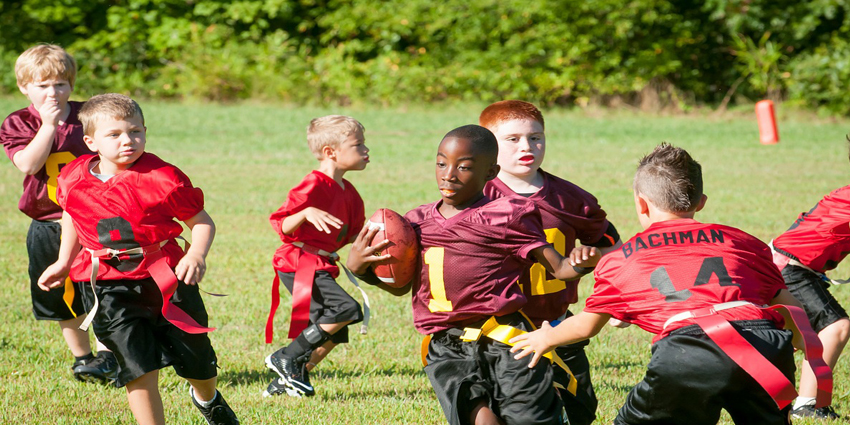
While youth flag football is a safer alternative to tackle football, head injuries are still of concern, a new study finds.
Understanding Head Impact in Flag Football
1 min read Premium comments
Secondary#flagfootball#headimpact
The researchers of “Head Impact Biomechanics in Youth Flag Football: A Prospective Cohort Study,” said that up till now data on youth flag football head impact biomechanics has been limited. So, in their study they describe head impact biomechanics outcomes in youth flag football and evaluate the factors related to head impact biomechanics.
They monitored 52 player-seasons among 48 male flag football players across 3 seasons. The average age was 9 years old.
The players wore head impact sensors during both practices and games. The sensors recorded head impact frequencies, peak linear and rotational acceleration as well as estimated impact location.
The impact rates were calculated as 1 impact per 10 player-exposures. Weekly and seasonal cumulative head impact frequencies and magnitudes were also calculated. The study was published online July 15 in The American Journal of Sports Medicine.
Overall, 429 head impacts from 604 exposures were measured (IR, 7.10; 95% CI, 4.81-10.50). Weekly and seasonal cumulative median head impact frequencies were 1.00 (range, 0-2.63) and 7.50 (range, 0-21.00), respectively.
The locations for the most frequent head impacts were the skull base (n = 96; 22.4%), top of the head (n = 74, 17.2%), and back of the head (n = 66; 15.4%).
The researchers found that the combined event type IRs (impact rates) differed among the 3 seasons (IRR range, 1.45-2.68). Games produced greater IRS (IRR, 1.24; 95% CI, 1.01-1.53) and peak linear acceleration (mean difference, 5.69g; p =.008) than did practices.
The older players, they also found, demonstrated greater combined event-type IRs (IRR, 1.46; 95% CI, 1.12-1.90) and increased head impact magnitudes than the younger players. The researchers estimated that every 1-year age increase associated with a 3.78g and 602.81 rad/s2 increase in peak linear and rotational acceleration magnitude (p ≤.005).
“Head IRs and magnitudes varied across seasons, thus highlighting multiple season and cohort data are valuable when providing estimates. Head IRs were relatively low across seasons, while linear and rotational acceleration magnitudes were relatively high,” the researchers wrote.
Author
React:
Discussion
This is a fascinating development. In my practice we've seen similar outcomes with the revised protocol. The key differentiator seems to be patient selection criteria. Has anyone else noticed the correlation with BMI thresholds?
Great point. I'd push back slightly on the conclusion, the sample size in the cited study is too small to draw population-level inferences. That said, the directional signal is compelling and worth a larger RCT.
We implemented a similar approach last year. Early results are promising but we're still gathering 12-month follow-up data. Happy to share our protocol if anyone is interested.
Join the conversation
Orthopedic professionals are discussing this. Sign in and upgrade to read every comment and add your voice.