
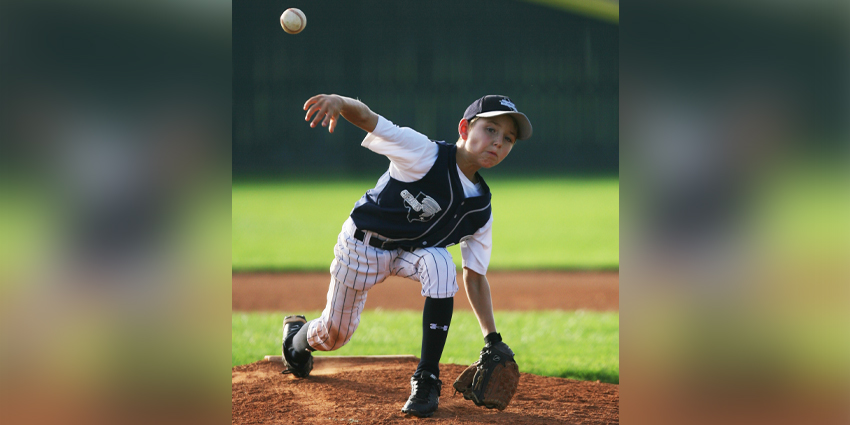
Baseball pitchers with an ulnar collateral ligament injury who started pitching younger than 10 years of age demonstrated greater dominant limb humeral retrotorsion and nondominant limb humeral retrotorsion than UCL-injured pitchers who started to pitch at 10 years or later, a new study finds.
Too Young Pitching Age Linked to Humeral Retrotorsion
1 min read Premium comments
Secondary#baseballpitcher#humeralretrotation#ulnarcollateralligamenttear
“Increased humeral retrotorsion (HRT) has been found to be a risk factor for ulnar collateral ligament (UCL) tears in baseball players. Recent work has demonstrated the age of 11 years as a potential watershed age for humeral retrotorsion development,” the researchers wrote.
In the study, “Effect of Younger Starting Pitching Age on Humeral Retrotorsion in Baseball Pitchers With an Ulnar Collateral Ligament Injury,” published on March 1, 2021 in The American Journal of Sports Medicine, the researchers hypothesized that “in a group of baseball pitchers with UCL injuries, athletes who started pitching before the age of 10 years will demonstrate significantly more dominant limb humeral retroversion when compared with a group of baseball pitchers who reported starting pitching at 10 years or older.”
For the study, they divided 84 baseball pitchers with a diagnosed UCL injury into two groups based on the age they started pitching. Overall, 33 had started pitching age 10 years or older while 51 had started to pitch younger than age 10.
The researchers measured the participants’ dominant limb humeral retrotorsion (DHRT) and nondominant limb humeral retrotorsion (NDHRT) using diagnostic ultrasound.
Overall, there were no significant differences between groups with regard to age at time of injury, height, weight, or playing years’ experience. However, there was a statistically significant difference in the participant-reported starting pitching age. The biggest differences between the two groups were noted for DHRTC (group 1: 20.0⁰±9.4⁰; group 2: 14.5⁰±10.3⁰; p = .015) and for NDHRT (group 1: 38.6⁰±8.8⁰; group 2: 32.9⁰±9.5⁰; p = .007. They did not find, however, any significant differences between groups for HRT diff (p = .940).
“The results of this study demonstrate that a younger starting pitching age results in increased HRT in players with UCL injuries,” the researchers wrote.
Author
React:
Discussion
This is a fascinating development. In my practice we've seen similar outcomes with the revised protocol. The key differentiator seems to be patient selection criteria. Has anyone else noticed the correlation with BMI thresholds?
Great point. I'd push back slightly on the conclusion, the sample size in the cited study is too small to draw population-level inferences. That said, the directional signal is compelling and worth a larger RCT.
We implemented a similar approach last year. Early results are promising but we're still gathering 12-month follow-up data. Happy to share our protocol if anyone is interested.
Join the conversation
Orthopedic professionals are discussing this. Sign in and upgrade to read every comment and add your voice.