
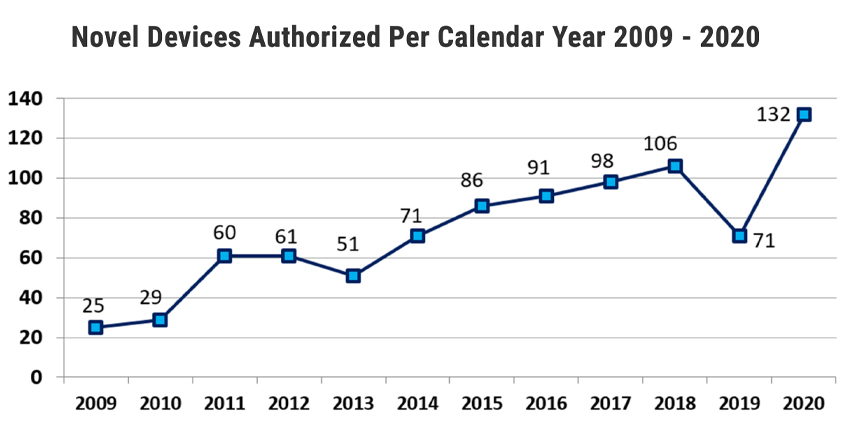
In the year of COVID 2020, the FDA approved, cleared, or authorized a record high 132 novel medical devices. That, according to agency’s device center leaders, surpassed the 40-year high mark set in 2018. Only 29 novel devices were authorized a decade ago, in 2010.
Novel Device FDA Authorizations Spike in 2020
3 min read Premium comments
#fda#novelmedicaldevices
Novel Device
A novel device, according to the FDA, isn’t just new, but addresses an unmet need, or may be safer or more effective than currently available alternatives. In other words, a breakthrough.
Novel devices include those brought to market through the premarket approval (PMA), humanitarian device exemption (HDE), and De Novo pathways, as well as a subset of those that are brought to market with 510(k) clearance or Emergency Use Authorization (EUA). Of the thousands of 510(k) clearances every year, the FDA considers only those devices with a breakthrough designation to be novel. In addition, in 2020 the agency included first-of-a-kind devices authorized under their EUA authority as novel devices.
Writing in a February 16, 2021 FDA Voices blog, Jeff Shuren, M.D., J.D., Director, Center for Devices and Radiological Health (CDRH) and William Maisel, M.D., M.P.H., Director, Office of Product Evaluation and Quality, CDRH, pointed out two novel orthopedic devices authorized in 2020.
The first, an anterior cruciate ligament (ACL) implant and, second, a high intensity focused ultrasound (HIFU), magnetic-resonance guided, ablation system.
The ACL implant, the Bridge-Enhanced ACL Repair (BEAR), is an alternative to ACL reconstruction to treat ACL tears. According to the FDA, the BEAR is, “unlike traditional reconstruction, does not require the use of harvested tendons for ACL repair and is the only currently-available alternative to reconstruction with allograft, autograft or suture-only repair for the treatment of ACL rupture.”
The ablation system is for the treatment of osteoid osteomas, a type of tumor, in the extremities. Osteoid osteoma is a benign painful bone tumor that occurs typically in the cortex of long bones of children and young adults.
Other novel devices noted by Shuren and Maisel included:
- The first game-based digital therapeutic to improve attention function in children with attention deficit hyperactivity disorder
- The first continuous renal replacement therapy device for a lower weight pediatric population with sudden or temporary loss of kidney function or fluid overload
- The first liquid biopsy next-generation sequencing companion diagnostic test
- The first cardiac ultrasound software that uses artificial intelligence (AI) to guide the user to capture quality diagnostic images
- The first-of-its-kind automated insulin delivery and monitoring system for use in young pediatric patients
- A high-density lipoprotein plasma delipidation system to reduce coronary artery atheroma in certain adult patients.
Shuren and Maisel wrote that no single factor contributed to the high number of novel devices seen in 2020.
“We know that the volume of Emergency Use Authorizations (EUA) for novel devices issued in 2020 played a role. Of the 625 EUAs the FDA issued for medical devices in 2020, many were for tests and sample collection devices, personal protective equipment (PPE), ventilators, and other types of devices as part of the agency’s COVID-19 response.”
Innovation Promotion
Shuren and Maisel say the agency is undertaking numerous activities related to device innovation.
For example, CDRH recently launched the Digital Health Center of Excellence to advance the development and FDA review of cutting-edge, digital health technologies. “We also continue to work through the Breakthrough Devices Program to provide breakthrough designation upon request to eligible devices, of which there are now over 400 devices. This designation offers an opportunity to interact with the FDA early and more extensively to address topics as they arise during the device development, evaluation, and premarket review phases.”
The FDA has now approved, authorized, or cleared 23 breakthrough devices through the PMA, De Novo or 510(k) pathway.
Work related to COVID-19 will remain their top priority in 2021, wrote Shuren and Maisel. “Although it is impossible to predict with certainty what the future will bring and whether the innovation pipeline in the U.S. will remain strong, CDRH will continue to adapt and shift resources to best protect and promote the public health.”
Author
React:
Discussion
This is a fascinating development. In my practice we've seen similar outcomes with the revised protocol. The key differentiator seems to be patient selection criteria. Has anyone else noticed the correlation with BMI thresholds?
Great point. I'd push back slightly on the conclusion, the sample size in the cited study is too small to draw population-level inferences. That said, the directional signal is compelling and worth a larger RCT.
We implemented a similar approach last year. Early results are promising but we're still gathering 12-month follow-up data. Happy to share our protocol if anyone is interested.
Join the conversation
Orthopedic professionals are discussing this. Sign in and upgrade to read every comment and add your voice.