
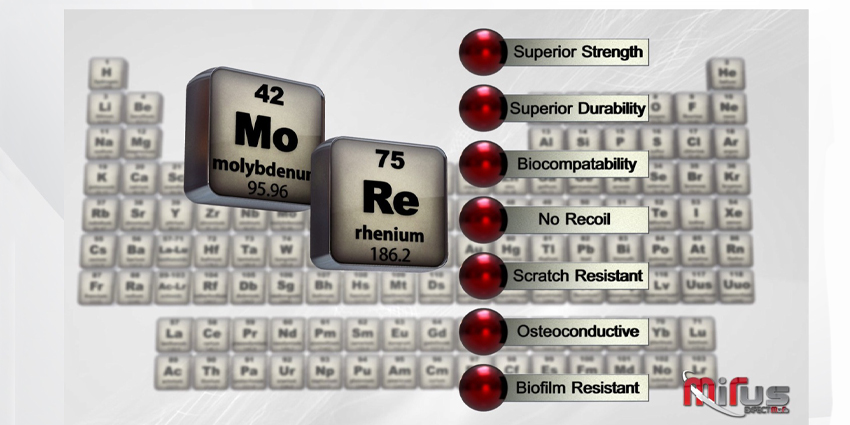
Marietta, Georgia-based MiRus, LLC has stepped up to offer a lifetime limited warranty on its Molybdenum-Rhenium (MoRe) superalloy rod technology.
Manufacturer Offers Lifetime Limited Warranty
2 min read Premium comments
Secondary#mirus#complexspinesurgery#morepromise
OTW asked Founder and CEO Jay Yadav how he and his team came to this decision. “We already knew from our dozen years of research and development on MoRe that it was much stronger and much more fatigue resistant than Ti [titanium] or CoCr [cobalt-chronium]. Extended surgeon experience in a variety of complex anatomies over the past 18 months, however, demonstrated that the superiority of MoRe to current alloys was even more remarkable than we had anticipated.”
According to the company, “The warranty will cover full replacement of the MoRe Rod and corresponding MiRus hardware used in spinal fusion cases should the MoRe Rod fracture. The warranty will cover all thoracolumbar MoRe rods implanted as part of the EUROPA Pedicle Screw System supplied by MiRus in the United States effective March 1, 2021.”
“Another interesting observation,” said Dr. Yadav to OTW, “was that surgeons visiting our headquarters for the past 3-4 years have been bending the same 4.5mm MoRe rod sample and even with bending, rebending of the same rod over 300 times, the rod has not fractured. So the combination of the basic science, clinical experience and anecdotal observation convinced us that the era of 15% – 20% of rods breaking in complex spine surgery could be put behind us. We felt that providing this lifetime warranty against rod breakage made clinical and business sense and would lead to more patients benefiting from MoRe technology and avoiding repeat surgeries.”
“Patients with advanced spine disease present a multitude of management and technical challenges for the spine surgeon. Complex spine surgery is difficult enough for the patient and the surgeon without having to worry about hardware failure. We want spine surgeons to know that we understand their frustrations and challenges and have developed the world’s most advanced medical alloy so they can provide reliable, durable surgery for their patients. Spine surgeons have also become jaded given the frequent hyperbole from spine companies so we are going beyond words and providing a lifetime warranty against rod failure. Spine surgeons have to stand behind their surgeries and we will be right there with them.”
Author
React:
Discussion
This is a fascinating development. In my practice we've seen similar outcomes with the revised protocol. The key differentiator seems to be patient selection criteria. Has anyone else noticed the correlation with BMI thresholds?
Great point. I'd push back slightly on the conclusion, the sample size in the cited study is too small to draw population-level inferences. That said, the directional signal is compelling and worth a larger RCT.
We implemented a similar approach last year. Early results are promising but we're still gathering 12-month follow-up data. Happy to share our protocol if anyone is interested.
Join the conversation
Orthopedic professionals are discussing this. Sign in and upgrade to read every comment and add your voice.