
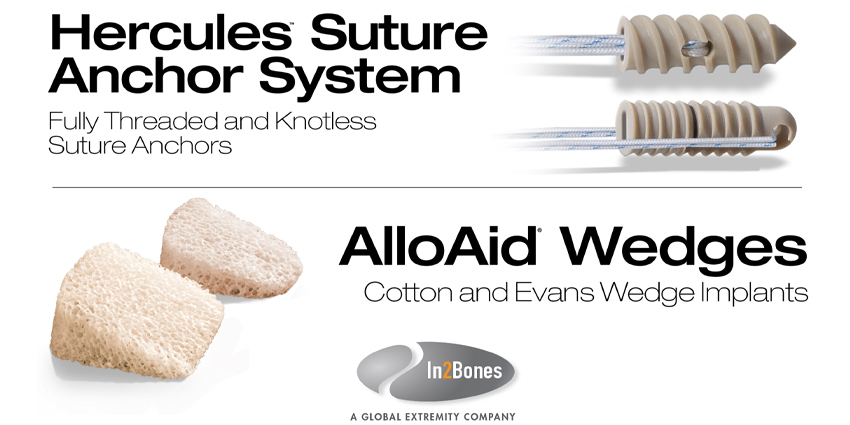
In2Bones Global, Inc. announces the launch of its Hercules Suture Anchor System and AlloAid Wedges in the U.S.
In2Bones Global Launches Hercules Suture Anchor System
1 min read Premium comments
Secondary#in2bonesglobal#alloaidwedges#herculessutureanchorsystem
These implant systems are designed for lower extremity surgeries in an effort to expand the company’s portfolio of pre-sterilized and OR-ready extremity products.
The Hercules Suture Anchor System gives surgeons the ability to choose between two PEEK-based implant families: Fully-Threaded and Knotless.
Special features of this system include radiolucent polyetheretherketone (PEEK) material with modulus similar to cortical bone and specific sizing for versatility of application. The system also comes with Knotless Suture Anchor which provides tensioning after implantation and BightForce Suture which as a soft, smooth surface that is gentle on soft-tissue and on surgeon gloves. The anchors are delivered sterile and already assembled.
“With the Hercules Suture Anchor System, In2Bones sees an opportunity for sales acceleration with soft tissue fixation for the multi-billion sports medicine market,” the company said in a statement.
The AlloAid Wedge system is designed for use during Cotton and Evans Osteotomies “…commonly performed during flatfoot reconstructive surgeries.” It comes with a pre-sterilized instrument set “…to allow precision implant sizing and placement.”
Both systems feature ultra-high molecular weight polyethylene sutures that improve the durability of the repair.
According to the company, these new systems will not only increase OR efficiencies and reduce related costs, they will also reduce risk of post-operative surgical site infections.
Another benefit of using In2Bone plants, according to the company’s website, is that all of their implants carry a Unique Device Identifier label which the Food and Drug Administration and the Centers for Medicare and Medicaid will soon be requiring for all patients with a small extremity implant.
In2Bones, headquartered in Memphis, Tennessee, is a global medical device company that focuses on treatment of disorders and injuries of both the upper and lower extremities.
Author
React:
Discussion
This is a fascinating development. In my practice we've seen similar outcomes with the revised protocol. The key differentiator seems to be patient selection criteria. Has anyone else noticed the correlation with BMI thresholds?
Great point. I'd push back slightly on the conclusion, the sample size in the cited study is too small to draw population-level inferences. That said, the directional signal is compelling and worth a larger RCT.
We implemented a similar approach last year. Early results are promising but we're still gathering 12-month follow-up data. Happy to share our protocol if anyone is interested.
Join the conversation
Orthopedic professionals are discussing this. Sign in and upgrade to read every comment and add your voice.