
On February 17, 2021, the FDA announced the approval of “a first in the world and first-of-its-kind implant” to replace the talus for the treatment of avascular necrosis (AVN) of the ankle joint. The approval came through the humanitarian device exemption (HDE) process. AVN is a progressive condition that causes a lack of blood supply and leads to the death of bone tissue.
Humanitarian Approval for “First-Of-Its-Kind” Bone Replacement
2 min read Premium comments
#3dprinting#bonereplacement#fdahumanitariandeviceexemption
3D-Printed Talus Spacer
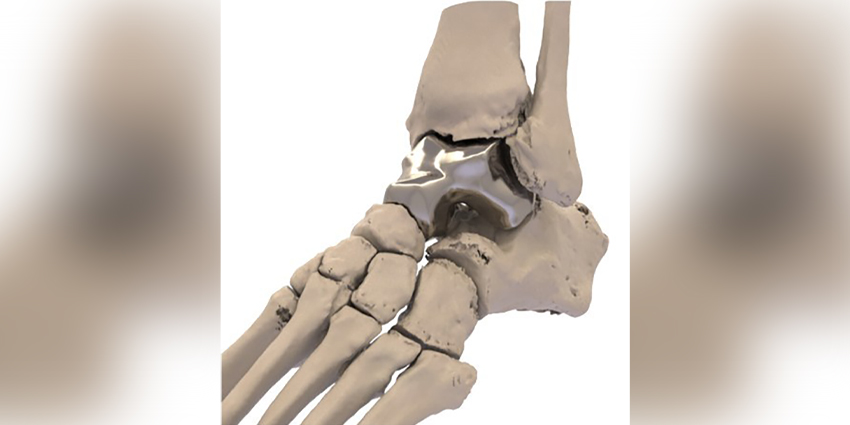
The 3D-printed Patient Specific Talus Spacer implant from New Jersey-based Additive Orthopaedics, LLC, can be used in talus replacement surgery. Using computed tomography (CT) imaging, the spacer is made individually for each patient. During the surgery, the patient’s talus bone is removed and replaced with the cobalt chromium alloy implant. The procedure, according to the FDA, offers an alternative to joint fusion or below-the-knee amputation for the painful, progressive condition that causes a lack of blood supply and leads to the death of bone tissue.
Avascular Necrosis
The damage to the bones of a joint, such as in the case of the ankle, causes the cartilage that keeps the bones from rubbing together to deteriorate, causing arthritis and pain. Late-stage AVN of the ankle may result in the talus bone partially or fully collapsing. The FDA press announcement stated, “Current available treatments include fusing the joints in the foot and ankle together—a procedure which helps to alleviate pain caused by AVN but eliminates motion in the joint—or below-the-knee amputation.”
Fusion may still be necessary in the future, but the surgery is intended to be a joint-sparing procedure, as it allows the patient to retain motion in the ankle joint.
The Data
The FDA reviewed data for the device through the HDE process, which means that the device is intended to treat or diagnose a disease or condition that affects no more than 8,000 individuals in the U.S. per year.
The data included results from 31 patients and 32 talus replacement surgeries (one patient had operations on both ankles) with the implant. Three years after surgery, the average reported pain decreased from “moderate to severe” to “mild”, and average range of motion in the ankle joint also improved. The measures were assessed using standard subjective scoring systems for pain and functionality.
After three years, out of 32 cases, there were 3 reported additional surgeries. The most common reported adverse events were pain and scar tissue at the surgery site.
Humanitarian Device Exemption Process
Going through the HDE process means your device is exempt from the effectiveness requirements of the FDA Act and is subject to certain profit and use restrictions.
Additive Orthopaedics President Greg Kowalczyk said, the device “is another example of how 3D printed devices can improve the standard of care. This is a tremendous regulatory win which took significant effort from our team and I want to thank everyone, including the U.S. Food and Drug Administration, who assisted in making this technology commercially available in the domestic market for patients suffering from AVN.”
The company plans an immediate launch of the spacer in the U.S.
Author
React:
Discussion
This is a fascinating development. In my practice we've seen similar outcomes with the revised protocol. The key differentiator seems to be patient selection criteria. Has anyone else noticed the correlation with BMI thresholds?
Great point. I'd push back slightly on the conclusion, the sample size in the cited study is too small to draw population-level inferences. That said, the directional signal is compelling and worth a larger RCT.
We implemented a similar approach last year. Early results are promising but we're still gathering 12-month follow-up data. Happy to share our protocol if anyone is interested.
Join the conversation
Orthopedic professionals are discussing this. Sign in and upgrade to read every comment and add your voice.