
Woburn, Massachusetts-based HD LifeSciences, LLC, a spinal interbody fusion device company, is expanding its patent portfolio with its patent for three-dimensional (3D) lattice structures for implants.
HD LifeSciences Grows Patent Portfolio
1 min read Premium comments
Secondary#misspinesurgery#hdlifesciences#additivemanufacturing
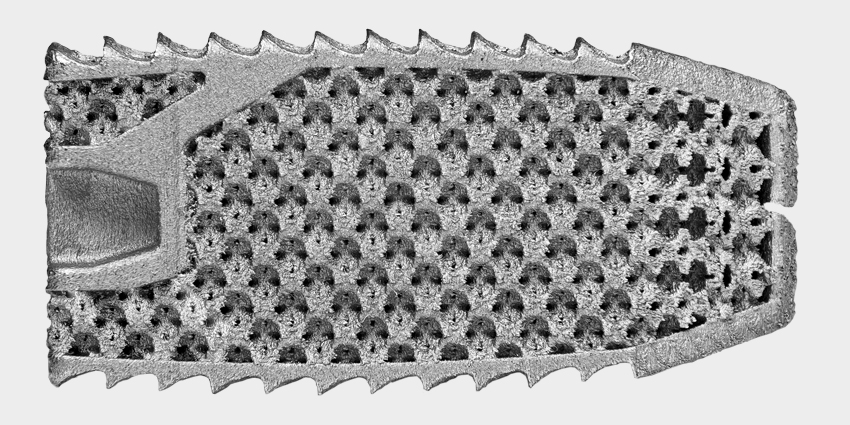
The newest addition to HD LifeSciences patent portfolio is U.S. patent number 10,888,429 B2. According to the press release, the patent is a “key element of intellectual property” related to “anisotropic load bearing, low stiffness, lattice structure, as well as the capability to tailor these properties to a specific purpose such as 3D printed titanium interbody cages.”
OTW spoke with company CEO Patrick O’Donnell about the patent’s importance. “The patent, specifically surrounding the anisotropic, low-stiffness lattice design, further distinguishes HD Lifesciences position as a pioneer and leading innovator in 3D printed interbody fusion cage technology. Additionally, the issuance bolsters an already prominent IP [intellectual property] portfolio.”
According to the company, “anisotropic lattice properties enable a method of reducing stress shielding of new bone growth in spinal fusion procedures. Similar to cancellous bone’s natural structure, this technology allows a lattice to exhibit mechanical properties varying with direction of force.”
The patent abstract states the following, “The three-dimensional lattice structures disclosed herein have applications including use in medical implants. Some examples of the lattice structure are structural in that they can be used to provide structural support or mechanical spacing. In some examples, the lattice can be configured as a scaffold to support bone or tissue growth. Some examples can use a repeating modified rhombic dodecahedron or radial dodeca-rhombus unit cell.”
HD LifeSciences Co-Founder and Vice President of Research and Development Ian Helmar explained, “This technology allows implants to further match physiological conditions as they vary with loading direction. Combined with the lattice’s internal volume curated to match the physiological dimensionality of bone substrates, this provides a strong tool for bone formation.”
Author
React:
Discussion
This is a fascinating development. In my practice we've seen similar outcomes with the revised protocol. The key differentiator seems to be patient selection criteria. Has anyone else noticed the correlation with BMI thresholds?
Great point. I'd push back slightly on the conclusion, the sample size in the cited study is too small to draw population-level inferences. That said, the directional signal is compelling and worth a larger RCT.
We implemented a similar approach last year. Early results are promising but we're still gathering 12-month follow-up data. Happy to share our protocol if anyone is interested.
Join the conversation
Orthopedic professionals are discussing this. Sign in and upgrade to read every comment and add your voice.